English
 中文简体

Content
- 1 What a Clamp-On Flow Meter Actually Measures and What It Cannot Tell You
- 2 Clamp-On vs In-Line Flow Meters: The Trade-Off in One Table
- 3 Where a Clamp-On Flow Meter Wins Without Argument
- 4 Where Clamp-On Meters Struggle, and Why Projects Go Wrong
- 5 Accuracy, Straight Run, and the Numbers That Decide the Project
- 6 A Buying Checklist for Clamp-On Flow Meters
- 7 When the Better Answer Is a Permanent Water Meter
- 8 Manufacturer, Supplier or Wholesaler: What the Sourcing Model Changes
- 9 Cost, Lead Time and Whole-Life Comparison
- 10 Frequently Asked Questions
- 10.1 Is a clamp-on flow meter accurate enough for billing?
- 10.2 Which pipe materials work best with a clamp-on flow meter?
- 10.3 How much straight run does a clamp-on meter need?
- 10.4 Can it measure low night flows for leak detection?
- 10.5 Do I have to measure wall thickness, or can I use the drawing?
- 10.6 Should I choose clamp-on or insertion?
- 10.7 Can a clamp-on meter be used on hot water or heating circuits?
- 10.8 What should I look for in a water meter manufacturer for permanent metering?
- 10.9 How do I validate a clamp-on survey result before reporting it?
A DN250 ductile iron main runs under a warehouse yard, it is live, and the utility needs to know by Friday whether the night flow in that zone is genuine leakage or a metering error. Nobody is cutting that pipe this month. This is exactly where a clamp-on flow meter earns its price: two transducers strapped to the outside of the pipe, a couplant, a measured wall thickness, and a usable number within the hour.
The short answer first. A clamp-on flow meter is the right instrument for surveys, temporary measurement, meter verification, and any pipe you cannot shut down. It is usually the wrong instrument for custody-transfer billing, for long unattended logging on a rough old main, and for any site where the pipe data cannot be verified. Decide whether you are buying a survey tool or a settlement device, and most of the technical argument disappears on its own.
The rest of this guide comes from the permanent side of that decision. We build water meters for a living, so we spend a lot of time looking at clamp-on readings that were taken to check whether our meters, or somebody else's, are telling the truth. That gives a fairly clear view of where the non-invasive approach shines and where it quietly produces numbers that nobody should sign off on.
What a Clamp-On Flow Meter Actually Measures and What It Cannot Tell You
Almost every clamp-on flow meter sold into water and HVAC work uses the transit-time principle. Two transducers sit on the outside of the pipe, one slightly upstream of the other. Each transducer alternately fires a short burst of ultrasound through the pipe wall, the liquid, and the far wall, and the meter measures the difference in travel time between the upstream and downstream paths. Because sound travelling with the flow arrives sooner than sound travelling against it, that time difference is proportional to the average velocity along the acoustic path. Multiply velocity by the internal cross-sectional area and you have volumetric flow.
The word "calculate" is doing a lot of work in that sentence. Before the meter can multiply anything, it needs four inputs that come from the outside world rather than from the instrument itself:
- Pipe outside diameter, which the installer usually measures with a tape.
- Wall thickness, which must be measured with an ultrasonic thickness gauge or taken from a reliable drawing.
- Pipe material, because the speed of sound in PVC, carbon steel, stainless steel and ductile iron differs enough to matter.
- Liner and internal condition, plus the assumed sound speed of the liquid at its actual temperature.
Get those inputs right and a good transit-time unit will hold roughly 1 to 2 percent of reading on a well-chosen installation, and the better devices with careful setup can reach around 0.5 percent on a clean, known pipe. Get them wrong and the meter will still display a confident number, which is the real risk. A wall thickness estimate that is 2 mm off on a DN150 main shifts the calculated internal diameter enough to move the area, and therefore the flow, by more than one percent before any electronics error is counted.
Where the Doppler variant fits
A second family, the Doppler clamp-on meter, reflects sound off particles or bubbles moving with the liquid. It needs reflectors to work, so it suits wastewater, slurries and heavily aerated flows where a transit-time unit would lose signal. The trade-off is that Doppler measures the velocity of the reflecting particles rather than the whole profile, which makes it a good trending and blockage-detection tool and a weaker choice for anything resembling a billing figure.
What no clamp-on meter can do
A clamp-on device measures what the sound path sees. It cannot inspect the inside of the pipe, so heavy tuberculation, a failing cement lining or a partly closed valve a few metres upstream will distort the profile without announcement. It also cannot create signal where there is none: entrained air, a slack flow condition, or a velocity well below the working range will produce dropouts rather than a low reading. And it cannot give you a legally recognised billing figure in most markets, because custody-transfer measurement normally requires a type-approved meter tested to ISO 4064 or an equivalent national approval, and portable clamp-on instruments are generally not approved for that role.
Clamp-On vs In-Line Flow Meters: The Trade-Off in One Table
The comparison that matters to a plant engineer or a water utility is not clamp-on against some abstract alternative, it is clamp-on against putting a real meter into the pipe. Both approaches measure flow honestly; they fail in completely different ways and at completely different cost points.
| Criterion | Clamp-on ultrasonic | In-line meter (ultrasonic, electromagnetic or mechanical) |
|---|---|---|
| Installation work | Transducers fixed to the pipe exterior, typically 20 to 60 minutes per point | Pipe cut and flanged or a spool piece fitted, several hours plus planning |
| Supply interruption | None | Shutdown, bypass or a planned night cut-in |
| Pressure loss | Zero, nothing intrudes into the flow | Zero for ultrasonic and electromagnetic, measurable for mechanical types |
| Typical accuracy | 1 to 2 percent of reading, better with careful setup on a known pipe | 0.5 to 1 percent of reading for electromagnetic and ultrasonic, around 2 percent for class 2 mechanical |
| Straight run | Often 10 diameters upstream and 5 downstream | Often 5 upstream and 3 downstream for electromagnetic, more for mechanical |
| Dependence on pipe data | High | Low, the bore is known because the meter defines it |
| Approval for billing | Usually not approved for custody transfer | Available with ISO 4064 or national metrological approval |
| Best use | Surveys, audits, verification, temporary and commissioning work | Permanent billing, district metering, remote reading and leak trending |
| Asset reuse | Portable units move between sites indefinitely | Fixed to one location for its service life |
Read the table from the bottom up if you are budgeting. A portable clamp-on kit is one purchase that serves fifty sites, which is why it survives in every utility survey van. An in-line meter is fifty purchases, one per site, each with its own chamber, flanges and commissioning. That is the honest economic comparison, and it explains why the two technologies coexist rather than compete.
The accuracy row deserves a warning about how figures are quoted. A clamp-on accuracy of 1 percent of reading is a statement about repeatability under favourable conditions, not a guarantee that your particular installation on a 40-year-old main will hit it. An in-line meter's 0.5 percent comes from a factory wet calibration in a bore of known dimensions. When a client tells us their clamp-on survey disagreed with the installed meter by eight percent, the argument is rarely about which device is better. It is almost always about which one was measuring the pipe that actually exists.
Where a Clamp-On Flow Meter Wins Without Argument
There are situations where the non-invasive option is not merely convenient but the only professionally defensible choice. Knowing them makes the purchasing conversation much shorter.
Verifying an existing meter
The classic case. A DN200 electromagnetic or Woltman master meter has been in service for eight years and the billed volume no longer matches the reservoir drawdown. A portable clamp-on meter strapped to the same pipe, downstream of any disturbance and with a measured wall thickness, gives an independent second opinion within an hour. If the two agree within a few percent, the meter is probably fine and the losses are real. If they diverge by ten percent, you have a strong reason to pull and test the installed meter. This check is the single most valuable job a clamp-on meter does in a water utility.
District metering and night-flow studies
Temporary zone metering often runs for two to six weeks while a leakage team narrows down a problem area. Installing permanent meters in four candidate zones before you know which one matters is wasteful. A clamp-on logger with a battery pack and a week of memory gives the shape of the night-flow curve, and the shape is usually enough to decide where the money goes.
Pipes that cannot be shut down
Hospital cooling loops, data centre chilled water, continuous process lines, and any raw water main feeding a single-source town. The cost of a shutdown frequently exceeds the cost of the instrument by an order of magnitude, and the clamp-on unit needs nothing but clean access to a stretch of pipe.
Large diameters and expensive bores
Above roughly DN400, the price of an in-line electromagnetic or ultrasonic meter rises steeply, and so does the cost of the chamber, the bypass and the lifting equipment. A clamp-on survey on a DN800 main is a fraction of that outlay, which is why clamp-on is standard practice for one-off flow checks in transmission mains.
Aggressive, hygienic or high-purity liquids
Nothing wetted means nothing to corrode, foul or clean. Chemical dosing lines, food-grade circuits and demineralised water loops are natural clamp-on territory, provided the pipe material transmits ultrasound well. Plastics are usually excellent; lined carbon steel and concrete are not.
Commissioning and temporary flow measurement
During commissioning, flow needs are transient and the piping layout is still being adjusted. A portable unit that can be moved three times in a week is far more useful than a meter bolted into a line that will be re-routed next month. The same logic applies when a temporary bypass is running and no permanent instrument exists in that leg.
A practical note on permanent smart metering: the advantages of non-invasive measurement in a survey are not the same as the advantages of non-invasive measurement in billing. When a utility later decides to make that zone permanent, the conversation moves to in-line devices with approval, telemetry and a defined service life, and the reasons are set out in more detail in our review of ultrasonic water meters against traditional mechanical designs.
Where Clamp-On Meters Struggle, and Why Projects Go Wrong
Most disappointing clamp-on results are not instrument failures. They are installation and pipe-condition failures that were invisible at the quotation stage. These are the conditions worth checking before anyone signs a purchase order.
Unknown or unmeasurable wall thickness
If the pipe is coated, wrapped, or too hot to touch safely, thickness measurement gets skipped and someone enters a nominal figure from a 30-year-old drawing. On a DN150 pipe, being 1 mm out on wall thickness changes the internal diameter by roughly 1.3 percent and the area by about 2.7 percent. That is a bigger error than the entire electronics chain of a good meter. Always insist on a thickness reading at the exact transducer location.
Heavy scale and tuberculation
Internally scaled steel pipe presents a smooth outside and a rough inside. The acoustic path scatters, the effective bore is smaller than the calculation assumes, and the measured velocity profile is distorted. Readings can drift by several percent, and the drift is not constant, so it cannot be removed with a single correction factor.
Cement-lined and non-homogeneous pipes
Cement mortar lining, concrete pipes and some composite pipes attenuate or scatter ultrasound badly. A meter may work on one section and fail completely 30 metres downstream on the same main, which makes trial installation essential.
Air, low pressure and slack flow
Entrained air from a poorly placed pump suction, a partly empty main, or a gravity line running below full bore will break the acoustic path. The symptom is not a wrong number but a missing one, with the meter cycling between valid and invalid readings. Any site with a history of air problems should be treated as an in-line application.
Low velocity, exactly where leakage hides
This is the most underappreciated limitation. Clamp-on transit-time meters need a decent velocity to resolve the time difference cleanly, and the practical floor is often around 0.2 to 0.3 m/s depending on pipe size, pipe material and electronics. Night-flow leakage signatures, unfortunately, live in the 0.05 to 0.15 m/s region on large mains. A meter that reads perfectly at daytime peak flow can drop out entirely at 3 a.m., which is precisely when the data was needed. If night flow is the objective, choose an instrument with a stated low-flow capability and verify it on site, or use a permanent meter with a wide turndown.
Access and geometry
Ten diameters of straight run is a comfortable target and often an impossible one. Insulated pipes, buried mains with only a small exposed section, pipe in a crowded plant room, and vertical runs with no safe working platform all constrain where transducers can go. The upstream path must also be free of a partly closed valve, a reducer right before the measurement point, or a bend in the wrong plane.
Couplant, temperature and long-term attachment
Handheld surveys use couplant gel or grease, which dries out. A transducer left on a hot pipe for a six-week logging campaign needs high-temperature couplant and proper clamping, or the signal will degrade halfway through and the data set will be worthless. Fixed installations also need protection from weather, condensation and accidental knocks.
- Check wall thickness at the exact measuring point, not from a drawing.
- Confirm the pipe material by tapping, magnet or drawing before entering it into the meter.
- Run a two-week trial on any pipe older than 20 years.
- Compare against a second measurement point or a portable reference before trusting the trend.
- Record a zero-flow check if the line can be isolated, even briefly.
Accuracy, Straight Run, and the Numbers That Decide the Project
When a survey result is challenged, the argument always comes down to the error budget. It helps to see where the uncertainty actually accumulates in a typical clamp-on installation, because the electronics are rarely the largest contributor. The chart below is an illustrative budget for a competent installation on a pipe whose data is partly assumed rather than measured.
Three of the five blocks in that chart are installation issues rather than instrument issues, and together they account for roughly three quarters of the total. This is why two identical clamp-on meters can produce results six percent apart on the same pipe: one installer measured the wall thickness and found ten diameters of clean run, the other did not.
The flow profile block is the one that catches out experienced people. A transit-time meter derives average velocity from one or two acoustic paths, and it assumes the profile is reasonably developed and symmetrical. A bend two diameters upstream creates a swirl that biases the path measurement, and the bias persists downstream for many diameters. The usual guidance of ten diameters upstream exists for that reason, and the correct response when the run is short is not to ignore the guidance but to move the measurement point, install a flow conditioner, or accept a wider uncertainty band in the report.
The liquid sound speed block matters more in temperature-varying systems than in cold water. A chilled water loop swinging between 5 and 15 degrees Celsius changes the speed of sound in water by a small but nonzero amount, and a meter set to a fixed value will drift slightly. Modern units compensate using a temperature input, and it is worth confirming that the compensation is enabled rather than left at a default.
The electronics block is the one buyers tend to negotiate over, and it is the smallest. Chasing a device with 0.5 percent stated accuracy while installing it on an unmeasured, scaled, 35-year-old main is a poor use of a project budget. Spend the effort on the pipe data and the location instead, and if the application needs certainty that no survey can deliver, the honest answer is to install a permanent meter whose bore is defined by the manufacturer and whose calibration is traceable. That is the path that removes the top block of the chart entirely.
A Buying Checklist for Clamp-On Flow Meters
Whether the budget is for one portable kit or a fixed unit for a single critical line, the same questions decide whether the purchase is useful a year later. Run through this list before comparing prices.
- Define the purpose in writing. Survey, verification, temporary logging or permanent monitoring each imply a different specification, and mixing two purposes in one device usually produces a compromise.
- Confirm the pipe inventory the instrument must handle: diameter range, materials, wall thickness range and liner types.
- Budget for an ultrasonic thickness gauge and train someone to use it. This single accessory improves results more than any upgrade in the meter itself.
- Check the low-flow specification honestly against the flows you expect at night, not the flows you expect at noon.
- Confirm the transducer temperature range covers your hottest and coldest line, with margin.
- Decide the outputs you need now and in three years: pulse, 4 to 20 mA, Modbus, SD card logging, or wireless upload.
- Check the ingress protection rating against the actual location, especially for outdoor chambers and plant rooms with washdown.
- Ask what couplant is supplied and whether replacement is a standard consumable in your region.
- Ask for the calibration certificate and its traceability, and note the recommended recalibration interval.
- Confirm the mounting hardware. Straps are fine for a survey, but a fixed installation on a vibrating pipe needs something better.
- Ask about training and whether the supplier will support a first installation on site, which is often the difference between a working kit and a shelf ornament.
- For fixed installations, confirm how the readings will be validated at commissioning and who signs the acceptance record.
Two commercial points are worth adding for buyers in a tender process. First, ask for the uncertainty statement in writing, covering the pipe conditions you actually have, rather than a single headline accuracy figure. Second, ask what happens when the installation does not perform. A supplier who can explain the failure modes before the order is placed is usually the one who supports you afterwards.
When the Better Answer Is a Permanent Water Meter
Sooner or later the survey ends and someone asks a different question: how do we measure this line for the next ten years, bill from it, and see it remotely at 2 a.m. without sending a technician with a tube of couplant? That is a permanent metering question, and the selection logic changes completely. Device cost becomes secondary to service life, approval and data continuity.
The first candidate in most clean water applications is an in-line ultrasonic meter. With no moving parts and a straight-through bore, it handles low flows better than a mechanical meter, holds accuracy across a wide turndown, and can be supplied with a valve for remote shut-off or with battery-powered wireless communication. For district metering and commercial billing where night-flow resolution matters, this is the practical replacement for the clamp-on logger that started the investigation.
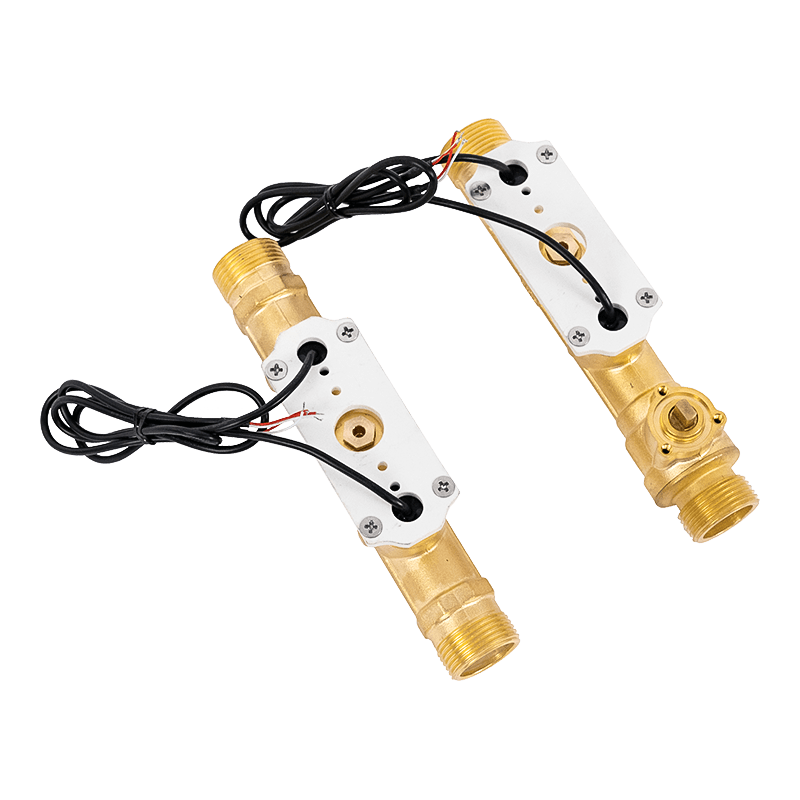 Ultrasonic Cold-Water Meter for Clean Water LinesOffers non-contact time-difference measurement, strong low-flow performance, and remote reading options for district metering and commercial billing.View Product →
The second candidate is electromagnetic, and it is the right answer in a specific set of conditions: conductive fluid, a pipe that is genuinely dirty or slightly aerated, and a diameter large enough that a full-bore magnetic meter is affordable. Electromagnetic meters tolerate suspended solids that would defeat a transit-time measurement, which makes them the standard choice for raw water, wastewater and many industrial lines. Where a clamp-on unit keeps dropping out because of entrained air, an electromagnetic meter usually reads steadily.
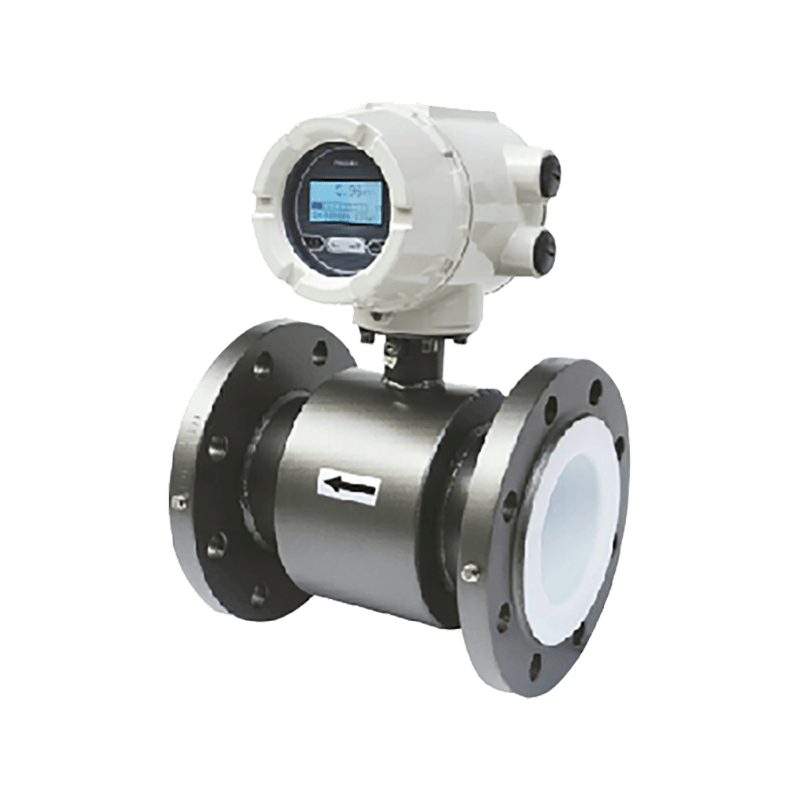 Electromagnetic Water Meter for Dirty and Aerated LinesHandles conductive fluids with suspended solids, bidirectional flow, high accuracy, IP68 protection, and remote communication for wastewater and industrial applications.View Product →
The third candidate is the traditional mechanical approach, and it is still the most economical for large clean-water mains where the budget per diameter point matters. A horizontal Woltman type meter with a detachable mechanism gives a low cost per DN at sizes where electronic meters become expensive, and the measuring element can be serviced without removing the body from the line. The conditions are a reasonably clean fluid, a strainer upstream, adequate straight run, and a flow range that stays inside the meter's working band.
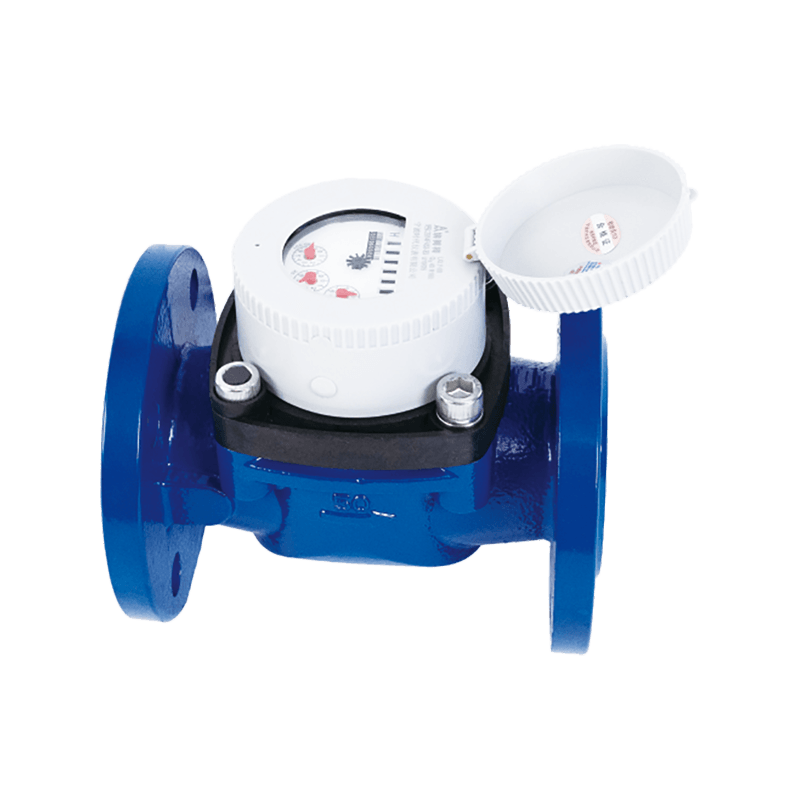 WPD Horizontal Detachable Woltman Water MeterProvides economical large-flow measurement with a detachable movement, built-in strainer, and maintenance access for clean-water mains and factory pipelines.View Product →
Choosing between them is mostly a matter of matching the meter to the pipe rather than to the brochure. The matrix below is the short version we use in project discussions.
| Site condition | Clamp-on survey suitable | Preferred permanent solution |
|---|---|---|
| Clean treated water, billing required, low night flows | For initial verification only | In-line ultrasonic meter with approved accuracy class |
| Raw water or lightly solids-bearing flow | Doppler variant for trending | Electromagnetic meter, full bore |
| Large clean main, tight capital budget | Useful for sizing checks | Woltman type mechanical meter with strainer |
| Heavily scaled old steel main | Unreliable, trial first | Replace a section and fit a full-bore meter |
| Short straight run in a plant room | Poor, profile bias likely | Full-bore meter with a flow conditioner |
| Remote site, no power, no network | Battery logger for a campaign | Battery-powered meter with wireless upload |
One point that catches procurement teams: a permanent meter is not simply a clamp-on device bolted down. It carries metrological approval, a defined bore, a stated service life and a support chain for spares and recalibration. That is a different product category with a different purchasing process, and it is worth separating the two line items in the budget from the start.
Manufacturer, Supplier or Wholesaler: What the Sourcing Model Changes
Once the decision moves to permanent metering, the next question is who you buy from, and the answer affects more than the invoice. A factory, a trading supplier and a wholesaler can all quote the same model number, but they deliver very different things when a project runs into trouble.
What a manufacturer brings
A production company controls the bore dimensions, the calibration process and the batch records. That matters when a utility auditor asks for a type approval certificate, a calibration trace or a statement of the materials used in a potable water path. It also matters when a specification needs adjusting, for example a pulse output ratio, a valve option, a communication module or a housing material. Working directly with the production side of an established manufacturer such as Ningbo Times Instrument, which operates under the AMICO brand with more than two decades in water metering and a 12,000 square metre production site, tends to shorten the loop between a technical request and a workable answer.
What a supplier or wholesaler brings
For a distributor serving several small utilities, a wholesaler offering consolidated shipments and local stock can be genuinely convenient. The trade-off is depth of technical support when a meter behaves unexpectedly in the field, and flexibility when a non-standard configuration is required. Neither model is wrong, but a buyer should know which one they are dealing with before the first shipment, because the difference only becomes visible after the sale.
Questions that separate the two quickly
- Can you provide the type approval and calibration documentation for the exact model quoted?
- Which parts of the meter are produced in your own facility and which are sourced?
- What is the minimum order quantity for a non-standard configuration, and what is the lead time?
- Who handles a warranty claim in our country, and what is the typical turnaround?
- Can you supply spare measuring elements, batteries and communication modules for the stated service life?
- Can you share project references of comparable size and application?
For OEM and private-label projects, the sourcing question becomes a development question. A manufacturer with in-house design capability can adjust a housing, a display, a communication protocol or a packaging configuration without a third party in the middle. That capability is worth confirming early, ideally with a factory visit or a documented process description, rather than discovering it halfway through a tender.
Cost, Lead Time and Whole-Life Comparison
Price per unit is the least informative number in this whole discussion. What matters is the cost of getting a trustworthy figure at a specific point in a specific pipe for a specific number of years. The table below compares the recurring elements rather than the headline price.
| Cost element | Portable clamp-on kit | Permanent in-line meter |
|---|---|---|
| Equipment purchase | One kit covers many sites | One meter per measuring point |
| Installation labour | Low per site, hours rather than days | Higher, includes flanging, commissioning and records |
| Process downtime | None | Planned shutdown or bypass |
| Civil and chamber works | Not required | Often required at large diameters |
| Calibration and verification | Periodic checks, can be informal | Factory calibration plus periodic verification to local rules |
| Typical service life | Five to ten years with careful handling | Ten to fifteen years for a quality device |
| Data delivery | Manual download unless a fixed logger is added | Built-in pulse, Modbus, NB-IoT, LoRa or Cat-1 options |
| Staff skill requirement | Trained technician per survey | Routine reading and periodic inspection |
The pattern in that table explains why the two instruments keep being purchased together. A utility buys one clamp-on kit and two hundred in-line meters, and the kit pays for itself in the first year by catching meters that are drifting, confirming zone losses and validating new installations before they are accepted. Treating the survey device as a capital item that supports the whole meter fleet, rather than as an alternative to it, is the view that usually survives a budget review.
Lead time is the other practical variable. Portable kits are often available from stock in standard configurations, while permanent meters with a specific diameter, communication module and approval marking are made to order. For a project with a fixed commissioning date, the meter order needs to be placed against the civil programme, not against the plumbing programme, because the approval documents and calibration certificates must be ready before the acceptance inspection.
Frequently Asked Questions
Is a clamp-on flow meter accurate enough for billing?
In most markets, no. Custody-transfer and utility billing normally require a meter with type approval to ISO 4064 or an equivalent national standard, installed in a fixed configuration with traceable calibration. A portable clamp-on instrument is generally treated as a survey and verification tool. It is excellent at telling you whether the billing meter is lying, which is a different and often more valuable job.
Which pipe materials work best with a clamp-on flow meter?
Homogeneous materials that transmit ultrasound well are the easiest: PVC, HDPE, stainless steel, copper and clean carbon steel. Cast iron and ductile iron usually work but need accurate wall thickness. Cement-lined pipe, concrete and heavily coated pipe are the difficult cases, and a trial installation is strongly recommended before committing to a campaign.
How much straight run does a clamp-on meter need?
Ten pipe diameters upstream and five downstream is a common target, and some manufacturers ask for more on certain transducer arrangements. The requirement exists because the instrument assumes a reasonably developed, symmetrical velocity profile. If the run is shorter, move the measurement point or accept a larger uncertainty in the result.
Can it measure low night flows for leak detection?
Often poorly. Many clamp-on transit-time meters lose reliable signal below roughly 0.2 to 0.3 m/s, and leakage signatures on large mains sit well below that. Check the stated low-flow performance rather than the maximum flow rating, and consider a permanent meter with wide turndown where night-flow data is the whole point of the exercise.
Do I have to measure wall thickness, or can I use the drawing?
Measure it. Drawings are frequently wrong, especially after decades of rehabilitation work, and the wall thickness feeds directly into the calculated bore. A 1 mm error on a DN150 pipe produces more error than the electronics contribute. An ultrasonic thickness gauge is the cheapest accuracy upgrade available for a clamp-on survey.
Should I choose clamp-on or insertion?
Insertion meters use a probe through a tapping and therefore see the flow more directly, with less dependence on pipe wall condition. They need a small wet tapping, so they are not completely non-invasive, but they often outperform clamp-on on old or lined pipe. If a shutdown for a single tapping is acceptable, insertion is worth considering.
Can a clamp-on meter be used on hot water or heating circuits?
Yes, within the transducer temperature range, and it is common practice on heating and chilled water loops. The practical constraints are high-temperature couplant, thermal expansion of the mounting hardware, and the sound speed compensation for the actual water temperature. Where the heating circuit also needs energy measurement, a permanent heat meter is the more appropriate long-term device.
What should I look for in a water meter manufacturer for permanent metering?
Approval documentation for the exact model, in-house calibration, a stated service life, spare parts availability, communication options that match your network, and a support route in your country. Ask for project references of similar diameter and application, and confirm what happens if a delivered batch fails acceptance testing.
How do I validate a clamp-on survey result before reporting it?
Three checks do most of the work: confirm the wall thickness at the measuring point, run a zero-flow check if the line can be isolated, and compare against a second measurement point or an independent instrument. If all three agree, the number is defensible. If any of them cannot be done, state the limitation in the report rather than presenting a single figure as fact.
A clamp-on flow meter is one of the most useful instruments a water utility or plant engineer can own, provided it is bought for the job it actually does. It finds the leak, checks the meter, measures the pipe nobody can shut down, and gets a number in an hour on a main that would otherwise need a shutdown and a crane. It does not replace the device that bills the customer, and no amount of accuracy on the datasheet changes that.
The practical sequence that works, in our experience of supporting projects on the permanent side, is straightforward. Survey with the clamp-on kit, record the pipe data honestly, report the uncertainty alongside the reading, and then install a permanent meter where the money is actually being accounted for. That way the survey pays for itself twice: once by finding the real problem, and again by preventing an expensive meter from being installed in the wrong place.
Explore the permanent side of the decision
If the next step is a fixed metering solution rather than another survey, the full AMICO water meter product range covers ultrasonic, electromagnetic, Woltman and smart communicating designs, with technical documentation available for specification and tender work.