English
 中文简体
中文简体
Content
- 1 How the Different Types of Water Meters Are Classified
- 2 Velocity Water Meters: Single-Jet and Multi-Jet
- 3 Volumetric Water Meters: Positive Displacement Accuracy
- 4 Woltman Detachable Water Meters for Large-Diameter Lines
- 5 Electronic Water Meters: Ultrasonic and Electromagnetic
- 6 Smart Functions Built on Top of Every Meter Type
- 7 Comparing the Different Types of Water Meters at a Glance
- 8 Application Scenarios and Water Meter Selection Points
- 9 Water Meter Maintenance and Service Life
- 10 FAQ: Different Types of Water Meters
- 10.1 What are the main different types of water meters?
- 10.2 Which water meter type is most accurate for residential billing?
- 10.3 What is the difference between a single-jet and a multi-jet meter?
- 10.4 Can an existing mechanical meter be upgraded to remote reading?
- 10.5 How long do different types of water meters last?
- 10.6 What size water meter should I order?
- 11 Choosing a Water Meter Manufacturer and Supplier
- 12 AMICO Water Meter Resources and Further Reading
A slowly leaking cistern can waste hundreds of liters a day, yet a meter with a blunt low-flow threshold will bill none of it. That gap between the water actually used and the water actually invoiced is the practical reason the different types of water meters exist: each family trades purchase cost, measuring accuracy and management features in a different way, and a wrong trade shows up quietly on the revenue side.
The short answer comes first. Nearly every meter on the market belongs to one of two working families. Mechanical meters measure flow with moving parts and include single-jet, multi-jet, volumetric (positive displacement) and Woltman turbine types. Electronic meters measure flow without moving parts and include ultrasonic and electromagnetic types. On top of either family, manufacturers layer smart functions such as pulse output, valve control, prepaid IC card payment and wireless reading over NB-IoT, LoRa or Cat-1 networks.
This guide explains how each type works, where it performs best, what it costs to own, and how to match it to a specific line. It is written from the standpoint of a working manufacturer: Ningbo Times Instrument Co., Ltd, maker of the AMICO brand, has produced mechanical and smart water meters since 2001 and supplies every family described below.
Start from your flow profile and management needs, not from a brochure; the right meter type follows from how water actually moves through your network.
How the Different Types of Water Meters Are Classified
Three questions sort the market into a tidy map. First, what physical principle measures the flow? Second, what management function does the meter perform beyond registering volume? Third, how is the reading collected? Most purchasing confusion comes from mixing these axes, because a prepaid NB-IoT meter and a plain mechanical meter can share the very same measuring principle while differing completely in function and price.
By measuring principle, the industry recognizes three groups:
- Velocity meters, where the speed of the water turns an impeller. Single-jet and multi-jet meters cover homes and buildings, while Woltman meters cover large mains.
- Positive displacement meters, often called volumetric meters, where a chamber of known volume fills and empties so the meter counts volume directly instead of inferring it from speed.
- Electronic meters, where paired ultrasonic transducers measure transit time, or an electromagnetic coil measures the voltage induced in conductive water.
By function, a second layer of options attaches to any of those principles. The four configuration cards below cover most utility and property tenders:
Pulse output
A reed switch or Hall sensor emits one pulse per fixed volume, so the meter can feed a data logger, BMS or remote counter.
Valve control
An integrated electric valve lets the utility or property manager close supply remotely for arrears control or emergencies.
Prepaid IC card
Credit is loaded by IC card or Bluetooth; the valve stays open only while a balance remains on the account.
Wireless reading
NB-IoT, LoRa or Cat-1 modules push readings to a head-end system without a meter reader ever visiting the pit.
The mechanical and electronic families differ in more than accuracy class, and the split table below sets the trade-offs side by side before the detailed sections.
Mechanical water metersMeasure flow with moving parts: an impeller, a jet or a piston turned by the water itself. Strong points: low purchase cost, no power needed, decades of field familiarity, easy local verification. Watch-outs: bearing wear shifts accuracy over time, silt can jam mechanisms, and very low flows may go unregistered. Typical families: single-jet, multi-jet, volumetric piston, Woltman. |
Electronic water metersMeasure flow without moving parts, from transit-time ultrasound or electromagnetic induction. Strong points: wide R values, stable accuracy for years, digital outputs ready for AMI networks. Watch-outs: higher unit cost, battery end-of-life management, and electronic verification equipment on the test bench. Typical families: ultrasonic, electromagnetic, electronic digital. |
Classification is a two-axis decision: fix the measuring principle first, then choose the smart function layer that matches how you bill and manage.
Velocity Water Meters: Single-Jet and Multi-Jet
Velocity meters dominate residential water meter types because they are compact, inexpensive and well matched to the flow profile of a household, where demand sits in a moderate band for most of the day and spikes briefly at peak hours.
Single-jet water meters
A single jet of water strikes the impeller tangentially and sets it turning, and a magnetic coupling transmits the rotation to a dry-type register, so the dial stays clean and readable even when the water carries fine particles. Construction is simple, the parts count is small, and sizes from DN15 to DN25 cover the bulk of domestic demand. A hot water variant uses heat-resistant materials so the same compact body can serve boiler feed and hot water distribution up to about 90 degrees Celsius.
The trade-off is that the entire load passes through one bearing path, so water quality matters more than it does in the multi-jet design; an inlet strainer is cheap insurance.
Multi-jet water meters
Flow enters the measuring chamber through several orifices arranged around the impeller, so multiple jets strike the rotor symmetrically and bearing wear is shared evenly. That balance is why multi-jet meters hold their error curve for years, why they tolerate a range of installation positions, and why they remain the default choice for apartment billing, building sub-metering and light commercial service.
A dry-type register sealed against condensation, plus the availability of a pulse output version, makes the multi-jet family the workhorse for properties that later want remote counters without replacing the whole meter.
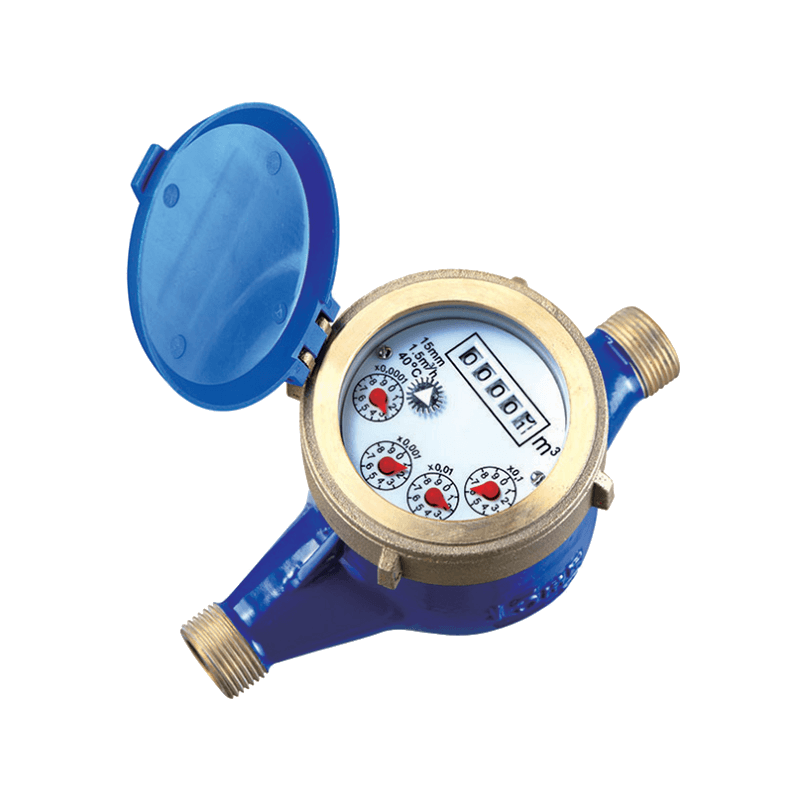 Multi-Jet Dry Water MeterMade of high-quality materials, copper or iron shells are optional. Available with cold or hot water. Dry dial, vacuum sealed, maintains clean readings for a long time...View Product →
Choose single-jet where budget leads and the water is clean; choose multi-jet where meters must stay accurate between long verification cycles and where a retrofit path may be needed.
Multi-jet meters remain the default for apartment billing because several jets share the wear, keeping the error curve flat for years.
Volumetric Water Meters: Positive Displacement Accuracy
Where billing disputes or extremely low flows are the concern, the volumetric meter is the mechanical family's precision instrument. Instead of inferring volume from rotor speed, a piston or oscillating disc traps a fixed volume of water, transfers it from inlet to outlet, and counts the cycles. The result is the best low-flow accuracy available in a mechanical meter, typically certified at R 160, in sizes from DN15 to DN40.
The family comes in horizontal and vertical installation forms, in lightweight plastic bodies for buildings where corrosion or weight matters, and in a stainless steel drinking water meter aimed at potable lines where hygiene requirements rule out conventional brass.
The precision has a price: chamber tolerances are tight, so grit and scale must be kept out with a strainer and periodic flushing, and the unit cost sits above a comparable multi-jet meter. In exchange, the buyer gains registration of the smallest continuous flows.
- Specify volumetric meters when water is scarce or expensive and every liter is revenue.
- Specify them where tariffs are exact and low-flow billing disputes are common.
- Specify them on potable lines that demand a stainless steel body.
When every liter is revenue, the volumetric piston meter is the most accurate mechanical choice at low flow.
Woltman Detachable Water Meters for Large-Diameter Lines
Above roughly DN50, the impeller changes shape: a helical rotor mounted axially turns in the flow like a ship's propeller, and the register sits in a gearbox on top. These Woltman meters, also called turbine or vertical screw meters, move large volumes with low pressure loss, which matters on mains where every millibar of head is worth defending.
Two installation forms cover the market. The WPD horizontal Woltman suits straight runs on transmission and distribution mains, irrigation networks and plant intakes. The WS vertical spiral-wing version fits chambers where the pipe rises vertically or where space is short. Typical sizes run from DN50 up to DN500 for large diameter water meter duty.
The defining feature of the family is in the name. The measuring insert is detachable, so the mechanism can be lifted out for calibration, repair or exchange without cutting the pipe or draining the line. Utilities keep a rotating stock of calibrated inserts and service the network with the main still in place, which cuts lifetime maintenance cost sharply.
The detachable insert is the Woltman's defining advantage: calibration and exchange happen without disturbing the pipeline.
Electronic Water Meters: Ultrasonic and Electromagnetic
Electronic meters remove the wearing part entirely. There are no bearings to load, no jets to silt up and no chamber to scale, because flow is derived from a physical property of the water itself. That is why the accuracy curve stays flat for years and why the economics increasingly favor these types for utilities.
Ultrasonic water meters
Paired transducers send ultrasonic pulses upstream and downstream; flowing water shifts the transit time between the two directions, and the difference is proportional to velocity. With no mechanical threshold to overcome, register ratios reach R 250 to R 800, so the meter bills the night trickle that mechanical meters ignore. Residential models use a lightweight plastic body, while the DN15 to DN40 valve versions pair a brass body with an integrated valve for remote shut-off. Transit-time measurement is also bidirectional, which district metering uses to spot reverse flows and network anomalies.
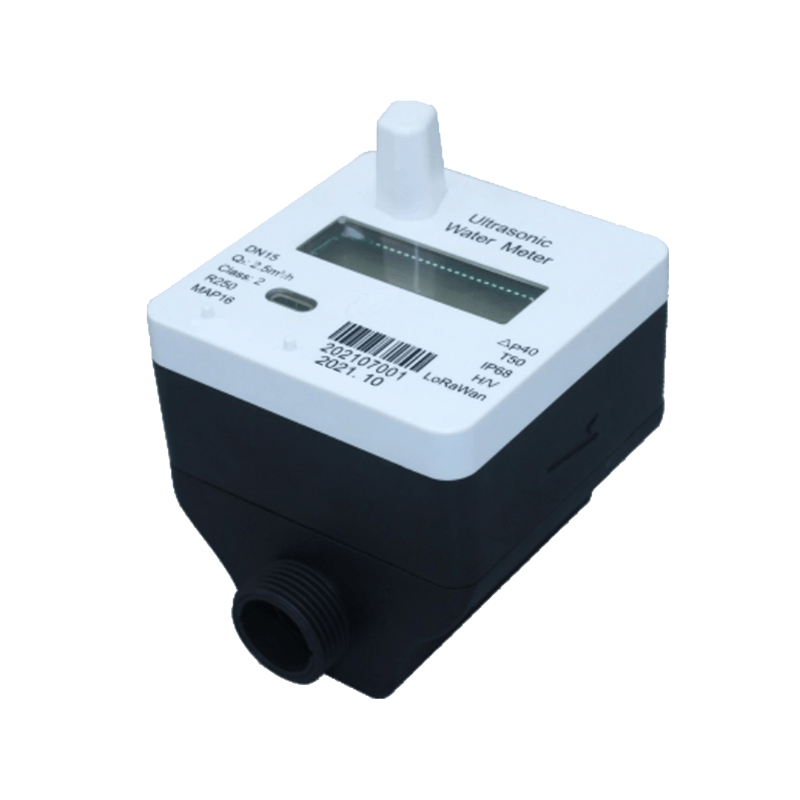 Plastic Ultrasonic Water MeterThe body shell is made of high-quality nylon material. High protection level and strong anti-interference ability. Light weight, simple installation and convenient cal...View Product →
Electromagnetic water meters
An electromagnetic meter applies Faraday's law: conductive water moving through a magnetic field induces a voltage proportional to its velocity, measured at electrodes in the lined bore. The principle is insensitive to density, viscosity and pressure changes, so it dominates raw water lines, industrial process measurement and district inflows from DN40 upward. It needs power for the coil, from mains or a large battery, and it requires minimum water conductivity, which rules out deionized water but not any normal supply.
The higher purchase price is recovered three ways: low-flow revenue that mechanical meters never register, longer intervals between verification because there is nothing mechanical to drift, and digital outputs that connect straight into AMI platforms without conversion hardware.
No moving parts means the accuracy curve stays flat for years, and that single fact is the whole economic case for electronic metering.
Smart Functions Built on Top of Every Meter Type
Meter type and intelligence are separate purchasing decisions. The families above describe how water is measured; the systems below describe how the measurement is managed. Any of them can attach to a mechanical or an electronic base meter.
Photoelectric direct reading
An optical sensor array reads the digits printed on the mechanical register, so the collected value is the same number a human reader would see, with zero transcription error and no reprogramming of the counting wheels. Photoelectric valve-controlled versions add a remotely operated valve for arrears management, and a vertical photoelectric model serves riser installations where the meter stands on a vertical pipe.
Prepaid IC card water meters
The prepaid family moves collection risk off the operator's books: credit is loaded onto an IC card or, on the Bluetooth version, straight from a phone, and the valve stays open only while a balance remains. The metering principle underneath is usually a standard single-jet or multi-jet mechanism, which keeps spare parts simple. Rental housing, dormitories and property-managed estates are the natural fit.
Wireless water meters: NB-IoT, LoRa and Cat-1
Three radio paths dominate remote reading. NB-IoT rides licensed cellular networks with deep penetration into basements and pits and very low power draw, which suits city-wide AMI rollouts. LoRa builds a private network under the operator's control, favored on campuses and industrial parks where gateway placement is easy. Cat-1 uses standard LTE where coverage is dense and higher bandwidth is wanted. Because these meters report hourly, the same network that collects bills also feeds minimum night flow analysis, and a continuous small loss on the analysis screen is usually a leak.
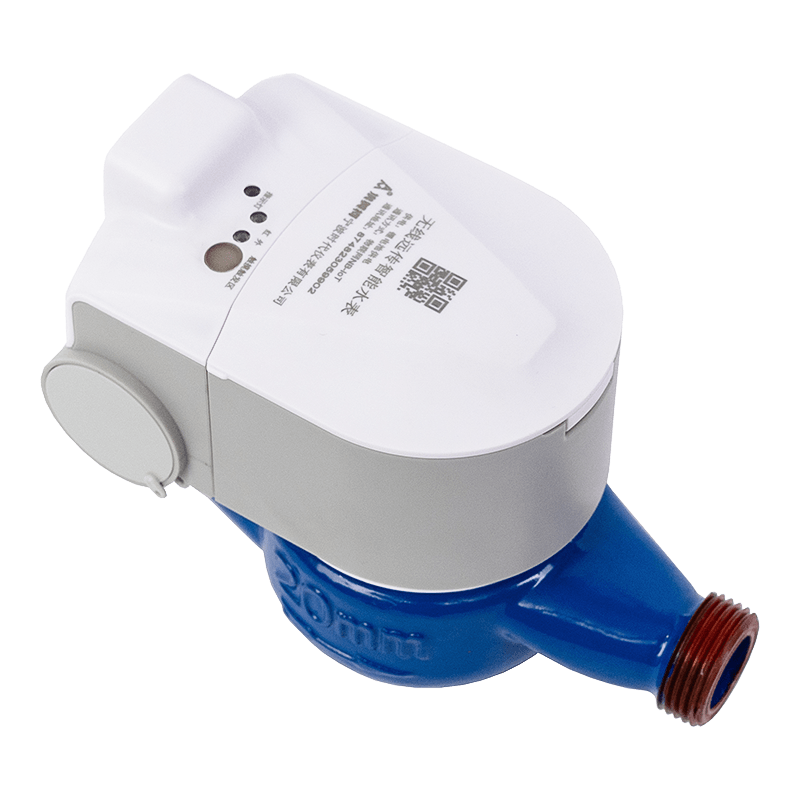 NB IOT Wireless Water MeterMade of high-quality materials, copper shell, iron shell or stainless steel body shell is optional. Available with or without valve. Available with cold or hot water. ...View Product →
Choose the communication module after the metering principle is settled, and never let the smart feature substitute for the accuracy underneath it.
Comparing the Different Types of Water Meters at a Glance
The most useful number for comparing meter families is the register ratio, written as an R value. R compares the meter's permanent flow rate Q3 with its minimum flow rate Q1, so a meter marked R 160 stays accurate down to one hundred and sixtieth of its nominal capacity. A higher R value means the meter bills correctly across a wider span of real-life flows, from a slow night trickle to a morning peak. Under ISO 4064, ordinary mechanical residential meters historically sat near R 80, while modern electronic designs reach far higher ratios. The bar chart below compares typical upper-bound R values for the six families covered in this guide.
Typical upper-bound register ratio (R value) by meter family
Higher means a wider accurately measured flow span; values are typical maxima and vary by model.
Dark bars mark electronic families; lighter bars mark mechanical families.
The pattern in the chart is consistent across manufacturers: electronic families lead on dynamic range, volumetric meters follow, and jet and Woltman designs trail. Ultrasonic meters reach R 250 to R 800 because the transit-time principle measures velocity digitally and has no mechanical threshold to overcome. That range is why an ultrasonic meter registers a leaking cistern that a conventional register never sees. Electromagnetic meters follow at around R 200 to R 400, a span that suits district metering, where night flow analysis drives leakage detection. Volumetric piston meters typically certify at R 160 because the measuring chamber captures discrete, known volumes of water. Single-jet and multi-jet meters usually sit at R 80 to R 100, which is adequate for apartment billing where flows are moderate and tariffs are simple.
Woltman meters show the lowest ratios on the chart, yet this rarely matters on the mains they serve, where flow seldom drops toward Q1. A high R value has direct revenue meaning, because water lost to unregistered low flows is unbilled water. In water-scarce regions, tenders increasingly specify R 160 or better for residential metering for exactly this reason. The right reading of the chart is not that electronic meters are always the answer, however. A multi-jet meter at R 80 remains the economical standard where water is inexpensive, tariffs are flat and flows are steady. Match the R value to your own flow profile and the price of water, and the chart becomes a shortlist rather than a verdict.
| Meter type | Measuring principle | Typical sizes | Typical R value | Best suited to |
|---|---|---|---|---|
| Single-jet | One tangential jet drives the impeller | DN15 to DN25 | R 80 to R 100 | Apartments, hot water lines |
| Multi-jet | Several jets strike the impeller evenly | DN15 to DN50 | R 80 to R 100 | Residential billing, sub-metering |
| Volumetric (piston) | A chamber fills and empties in known volumes | DN15 to DN40 | R 160 | Exact low-flow billing, drinking water |
| Woltman (detachable) | Axial helical turbine | DN50 to DN500 | R 50 to R 125 | District mains, irrigation, plant intake |
| Ultrasonic | Transit-time difference between transducers | DN15 to DN300 | R 250 to R 800 | AMI networks, leakage detection |
| Electromagnetic | Faraday induction on conductive water | DN40 to DN1000 | R 200 to R 400 | Raw water, industrial, district inflows |
The comparison reduces to one habit: profile the flow first, then let the R value and the management features pick the family.
Application Scenarios and Water Meter Selection Points
Scenario first, type second: the table below maps common applications to the family that serves them best, drawn from the product logic used across the AMICO range.
| Application scenario | Recommended meter type | Why it works there |
|---|---|---|
| Apartment and condominium billing | Multi-jet, dry-type register | Balanced jet wear keeps the error curve stable between long verification cycles |
| Riser and vertical pipe installations | Vertical volumetric or vertical photoelectric | Mechanics and register are designed for the vertical orientation |
| Hot water and boiler circulation lines | Single-jet hot water meter | Heat-resistant materials tolerate hot water up to about 90 degrees Celsius |
| High-value water, exact low-flow billing | Volumetric piston meter | The chamber principle captures the smallest continuous flows |
| District mains, irrigation, plant intake | Woltman WPD or WS | High flow capacity, low head loss and a detachable mechanism for service |
| Smart city AMI and remote reading | NB-IoT, LoRa or Cat-1 wireless | Hourly data without meter readers, wiring or site visits |
| Rental housing with payment collection risk | Prepaid IC card or Bluetooth prepaid | Pay first, and the valve closes automatically at zero balance |
| Potable water with strict hygiene demands | Stainless steel volumetric meter | A corrosion-free body suited to drinking water lines |
| District leakage and night flow monitoring | Ultrasonic or electromagnetic | High R values expose the small continuous losses that indicate leaks |
Five selection steps turn the table into a specification:
- Profile the flows: minimum night flow, average and peak; the ratio between them points to the R value required.
- Check the water: silt, hardness and temperature decide between jet, piston and electronic chambers, and whether a strainer is needed.
- Confirm the installation: available straight pipe, horizontal or vertical orientation, and the body length that fits the chamber.
- Decide the management mode: manual reading, pulse output, photoelectric bus collection, prepaid payment or wireless AMI.
- Cost it over ten years: purchase price plus verification, batteries, communication fees and the leakage revenue recovered.
The scenario table is a shortcut, but the five steps are the contract: flow profile, water quality, installation, management mode and total cost decide the order.
Water Meter Maintenance and Service Life
Maintenance planning differs more between families than purchase price does, so it belongs in the selection decision rather than after it. Mechanical meters drift as bearings and chambers wear, which is why most utilities re-verify residential meters every six to eight years and inspect large meters more often. Electronic meters skip that drift but introduce a battery schedule, typically a decade, after which the meter is exchanged or serviced.
| Meter type | Typical service or verification interval | Key maintenance task |
|---|---|---|
| Single-jet and multi-jet | 6 to 8 years | Clean the inlet strainer and check register seals and readability |
| Volumetric | 6 to 8 years | Keep grit out with strainers and flushing; verify chamber wear |
| Woltman | 2 to 4 year inspections | Use the detachable design to service or exchange the insert in place |
| Ultrasonic | About 10 years, battery life | Keep transducer faces clean and track battery status remotely |
| Electromagnetic | 8 to 10 years | Check electrode and liner condition and verify the excitation coil |
Three habits extend life regardless of family. Protect every meter from freezing, because a cracked body ends accuracy instantly. Fit and clean strainers ahead of jet and piston chambers in silt-prone networks. And for remote systems, test the communication route annually, because an unreported meter is operationally the same as a broken one.
Budget for the whole ownership cycle, not the invoice: verification, batteries and communication checks decide the real cost per billed cubic meter.
FAQ: Different Types of Water Meters
What are the main different types of water meters?Two families cover the market. Mechanical meters measure flow with moving parts: single-jet, multi-jet, volumetric piston and Woltman turbine types. Electronic meters measure flow without moving parts: ultrasonic and electromagnetic types. Smart functions such as pulse output, prepaid payment, valve control and wireless reading combine with either family. |
Which water meter type is most accurate for residential billing?At low flows, a volumetric piston meter is the most accurate mechanical option, typically certified at R 160. Ultrasonic meters match or exceed that across an even wider range, reaching R 250 to R 800. A multi-jet meter at R 80 to R 100 remains the economical standard where tariffs are simple and flows are moderate. |
What is the difference between a single-jet and a multi-jet meter?A single-jet meter directs one stream of water onto the impeller, which keeps the mechanism compact and inexpensive. A multi-jet meter splits the flow into several jets that strike the impeller evenly, so bearing wear is shared and accuracy holds longer between verifications. Multi-jet designs therefore suit long billing cycles better. |
Can an existing mechanical meter be upgraded to remote reading?Often yes. If the register is a dry type, a pulse-output module can usually be added to feed a counter or logger. Many owners instead replace the register or the whole meter with a photoelectric direct-reading version or a wireless meter. The right choice depends on whether the existing register is worth keeping and what collection network is already in place. |
How long do different types of water meters last?Mechanical residential meters usually serve about a decade before replacement, with verifications along the way, and Woltman mechanisms last far longer thanks to detachable inserts. Ultrasonic meters typically run ten years on the factory battery with no moving parts to wear. Electromagnetic meters last similarly, with periodic checks of electrodes and liner. |
What size water meter should I order?Size the meter to the flow profile, not to the pipe diameter. A meter matched to a DN25 pipe but passing only a trickle will undershoot its measuring range and miss low flows. Confirm minimum, average and peak flows first, then select the Q3 and R value that cover them. |
If a question is not answered here, the comparison table and the scenario list above usually settle it.
Choosing a Water Meter Manufacturer and Supplier
Meter type explains perhaps half of a purchasing decision; the manufacturer explains the rest. Look for a producer that controls machining, calibration and testing in-house, because meter accuracy is decided on the test bench, not in the brochure.
Ningbo Times Instrument Co., Ltd, part of the AMICO group, has manufactured water meters since 2001. The company operates a 12,000 square meter plant with more than 140 employees, holds over 1,000 completed engineering cases, and reports annual sales above RMB 100 million. Its catalogue spans every family described in this guide, from DN15 multi-jet mechanical meters to NB-IoT smart meters, photoelectric reading systems, prepaid IC card models and ultrasonic heat meters.
For utilities, property developers, engineering contractors and wholesalers, that breadth matters: a single supplier who delivers both the mechanical base meter and the smart overlay simplifies spare parts, verification and after-sales support. Whether you purchase as a wholesaler distributing standard models or as a utility specifying an AMI rollout, ask the manufacturer for flow-profile advice against your own network data before fixing the type.
A supplier who manufactures the full range can recommend a type honestly, because they are not forced to sell the one meter they have.
AMICO Water Meter Resources and Further Reading
The pages below extend the topics covered here, from the accuracy argument for ultrasonic metering to the complete AMICO range across every family described in this guide.
- The key advantages of ultrasonic water meters over traditional mechanical water meters
- The complete AMICO water meter product catalogue
Reading the catalogue alongside this guide turns type selection into a concrete, orderable shortlist.