English
 中文简体

Content
- 1 Match the Flowmeter to the Flow Profile Before Anything Else
- 2 The Flowmeter Families You Will Actually Choose Between
- 3 How the Main Meter Types Compare on Turndown
- 4 Specifications That Decide Whether the Meter Survives in the Field
- 5 Reading the Meter: From Pulse Output to NB-IoT
- 6 Buying Flowmeters in Volume: What to Ask Before the Order
- 7 Installation and Field Maintenance That Protect the Reading
- 8 Frequently Asked Questions About Flowmeters
- 8.1 What is the difference between a water meter and a flowmeter?
- 8.2 Which flowmeter is best for low residential flows?
- 8.3 How do I work out the right Q3 for a building?
- 8.4 Are ultrasonic flowmeters more accurate than mechanical meters?
- 8.5 What does the R value on a flowmeter mean?
- 8.6 Can a mechanical flowmeter be upgraded to remote reading?
- 8.7 What maintenance do water flowmeters need?
- 8.8 How do I choose a flow meter supplier or wholesaler for a bulk order?
- 8.9 Do flowmeters work on hot water and heating circuits?
- 9 Where the Decision Usually Ends Up
Picture a housing estate where every riser carries a DN20 meter installed a decade ago. Billed consumption has drifted below the district supply figure by roughly nine percent, and the utility has already repaired two bursts it never managed to trace. Nobody blames the meters until someone pulls the datasheet and discovers the installed units are rated Q3 = 4 m³/h at an R value of 80, while the flats behind them draw between 0.25 and 0.8 m³/h for most of the day. The meters have spent ten years sitting near the bottom of their measuring range, and the low-flow error band has quietly widened.
That is the practical reality of flowmeters in water supply. The hardware is rarely the villain; the match between hardware and flow profile usually is. A flowmeter is a device that turns the volume or velocity of moving water into something readable, whether that output is a mechanical counter, a pulse train, or a data packet leaving an NB-IoT radio. Choosing well means comparing three things at once: the flow range the building actually produces, the accuracy the billing model needs, and the conditions the meter will live in for the next ten years.
The notes below come from the factory side of that decision. They cover the meter families used in potable water, hot water and heating circuits, the specifications worth arguing about, and the questions worth putting to a flow meter manufacturer or supplier before a bulk order leaves the loading dock.
Match the Flowmeter to the Flow Profile Before Anything Else
Every water flowmeter datasheet carries four flow numbers, and they matter more than the price column. Q1 is the minimum flow at which the meter must stay inside its lower error band. Q2 is the transitional flow where accuracy tightens up. Q3 is the permanent or nominal flow the meter is designed to handle continuously. Q4 is the overload flow it must survive for short periods without damage. The ratio of Q3 to Q1 is the turndown, usually printed as an R value, and it is the single most useful number for judging whether a meter suits a building.
Take a DN15 multi-jet unit with Q3 = 2.5 m³/h and R = 160. Its Q1 works out at roughly 15.6 litres per hour. A two-person flat averaging 350 litres a day draws most of its water in short bursts well above that figure, so the meter spends plenty of time inside its accurate band. Now install a DN25 body with Q3 = 6.3 m³/h on the same flat. The pipework looks generous and the head loss is lower, but the everyday draw now sits much closer to Q1, and small leaks, dripping cisterns and overnight trickle flows start slipping below the registration threshold. The utility loses revenue it never sees on a balance sheet, and the customer's bill looks suspiciously low until the leak becomes a burst.
The opposite mistake costs money too. Undersizing a meter pushes it toward Q4 during morning peaks, which accelerates rotor wear and adds measurable head loss to the riser. In a high-rise building with a booster set, that extra pressure loss is paid for every hour of every day in pump energy.
How to size in practice
- Estimate the highest simultaneous demand at the meter, not the total daily volume. For a flat, that is usually the shower, the kitchen tap and a washing machine running together.
- Multiply that peak by roughly 1.3 to 2.0 to get the target Q3.
- Check that the lowest realistic continuous draw, including overnight leakage, stays comfortably above Q1 on the same datasheet.
- Confirm the pressure loss at Q3 is acceptable for the available head, especially on top floors and in boosted systems.
- Only then compare price, materials and communication options.
A meter is correctly sized when its Q3 sits at roughly 1.3 to 2 times the highest simultaneous demand and its Q1 still sits below the smallest draw the utility wants to bill.
The Flowmeter Families You Will Actually Choose Between
Water metering uses a narrower set of measuring principles than general industrial flow measurement. Most installations come down to five families, and each has a flow band and a water quality where it simply works better than the rest.
Multi-jet and single-jet mechanical flowmeters
These are the workhorses of residential metering. A multi-jet meter splits the incoming stream through several tangential jets that drive the impeller, which spreads wear across the rotor and keeps readings stable when upstream pipework distorts the flow. A single-jet meter sends the whole stream through one channel, so it is simpler, lighter and generally cheaper, but it is noticeably more sensitive to sand and grit in the line.
Typical DN15 to DN50 bodies carry Q3 ratings between 2.5 and 6.3 m³/h with R values from 80 to 160. Dry-dial versions keep the register sealed away from the water, which matters in hard water areas where wet dials can fog and become unreadable. Single-jet hot water variants are common on boiler outlets and domestic hot water branches, where the medium runs continuously above ambient temperature.
Volumetric and positive displacement flowmeters
A volumetric meter measures actual volume rather than inferring it from rotor speed. Water fills a chamber of known size, the piston or disc oscillates, and each cycle represents a fixed quantity. Because the chamber cannot fill partially without registering, these meters hold accuracy remarkably well at very low flows, often reaching R values of 160 to 250 in domestic sizes.
That makes them a natural choice for low-consumption households, sub-metering in apartments, and anywhere a utility wants small draws and slow leaks to show up on the bill. The trade-off is sensitivity: grit, scale or debris can jam the chamber, so a strainer upstream is not optional. Plastic-bodied versions handle aggressive water well, while stainless steel drinking water units are chosen where wetted metal quality is a specification item in its own right. Buyers comparing volumetric units usually find that the accuracy story is strong and the water quality story decides the outcome.
Woltman and turbine flowmeters for larger pipes
From DN50 upward, the economics shift. A Woltman meter uses a helical rotor aligned with the flow, giving high capacity with modest head loss, which is why it turns up on mains, risers, irrigation lines and bulk transfer points. Horizontal and vertical configurations exist because real plant rooms rarely offer a straight, level run of pipe.
Detachable designs let a maintenance team lift the measuring element out of the body without cutting the line, which shortens shutdowns considerably. Turbine meters do expect reasonable upstream and downstream straight lengths and clean water; a badly placed elbow directly ahead of the meter can bias the reading by a margin that no calibration will fix.
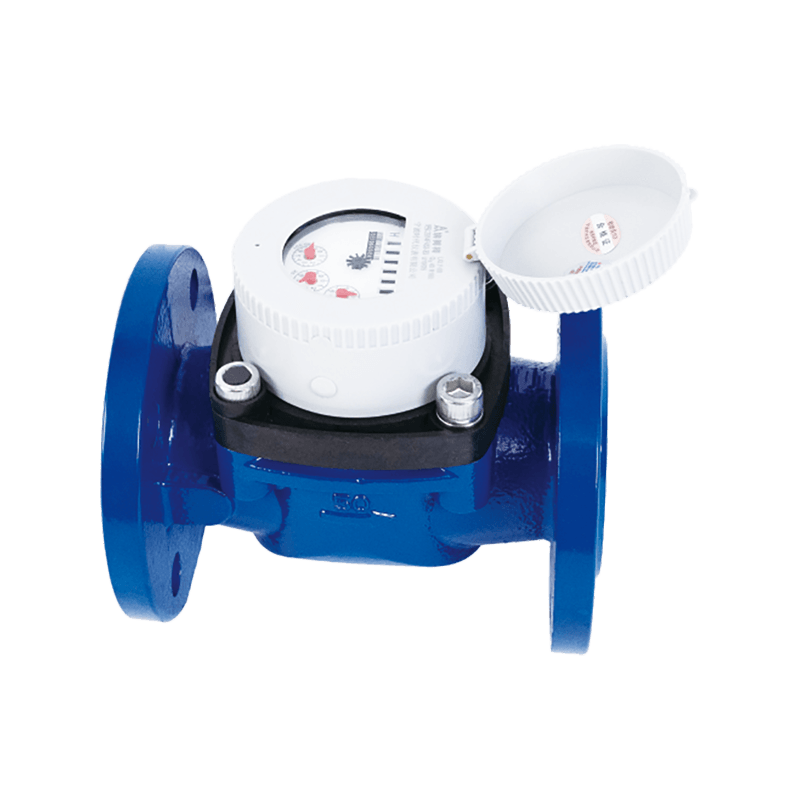 WPD Horizontal Screw-Wing Detachable Woltman Water MeterFor main pipelines and factory flows, this detachable Woltman design offers an interchangeable movement to simplify maintenance and shorten shutdowns.View Product →
Electromagnetic flowmeters
Electromagnetic meters apply Faraday's law to a conductive liquid passing through a magnetic field. With no moving parts and nothing protruding into the bore, they handle raw water, wastewater, and lightly loaded streams that would destroy a mechanical rotor. They typically need a minimum conductivity of a few microsiemens per centimetre, which potable and most raw waters comfortably exceed.
The practical requirements are grounding and straight run. A mag meter with a poor earth reference will drift, and no amount of calibrating fixes a signal that is being measured against a floating ground. They also cost more per unit, so they tend to appear at larger diameters and at points where reliability under difficult water conditions justifies the price.
Ultrasonic flowmeters
Transit-time ultrasonic meters send sound alternately up and downstream and calculate flow from the difference in travel time. Nothing obstructs the bore, so head loss is essentially zero, and the measuring range is wide enough to catch the small night flows that districts use to estimate leakage. Battery-powered versions can sit in a chamber for years and report periodically, which is why they have become common in district metering and commercial accounts.
The weak points are entrained air and disturbed flow profiles. Ultrasonic meters dislike bubbles, and a badly positioned installation downstream of a pump or a partly open valve will produce readings that look plausible and are wrong. Getting the straight lengths right at commissioning is cheaper than investigating phantom consumption a year later.
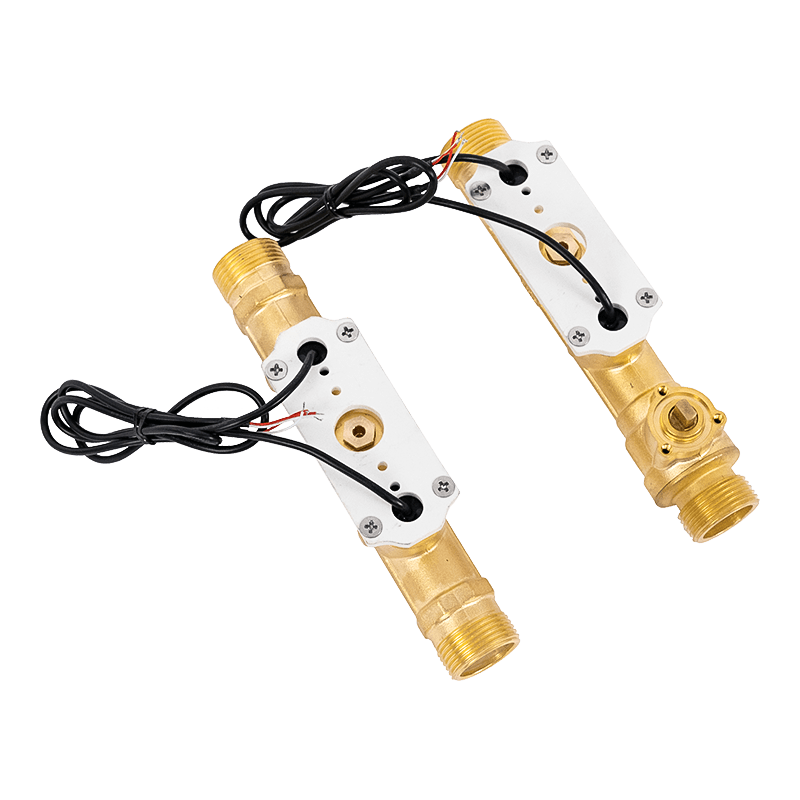 Ultrasonic Time-Difference Cold-Water Meter with Remote InterfacesA no-moving-part cold-water meter with low initial flow and RS-485, M-BUS, GPRS or wireless options; unsuitable for sewage or excessive bubbles.View Product →
Choose the meter family from the water first, then from the flow: dirty water rules out volumetric chambers, air entrainment rules out ultrasonic, and large diameters rule out traditional multi-jets.
How the Main Meter Types Compare on Turndown
Turndown ratios summarise how far below nominal flow a meter can still be trusted, and they are the fastest way to see why two meters with the same pipe size behave so differently on the same building. The chart below places the commonly quoted catalogue ranges side by side so the gap between a plain mechanical unit and an electronic one is visible at a glance.
Typical turndown ratio (Q3 / Q1) by water flowmeter type
Indicative ranges taken from common catalogue data. Always confirm the exact Q1 and Q3 figures on the datasheet for the model you are buying.
Read the chart as a comparison of measuring philosophy rather than a league table. A single-jet meter at R 80 is not a bad meter; it is a meter intended for steady, moderate flows where the extra turndown would never be used. Push the same unit into a block of low-occupancy flats and the low end of the scale starts to matter more than the purchase price.
The middle of the chart is where most procurement decisions land. A multi-jet at R 160 with pulse output covers household billing and gives the utility a signal for later remote reading. A volumetric unit at R 250 earns its place where small draws must be captured, which is why it is often specified for apartment sub-metering and refurbishment projects. Both remain mechanical instruments, so both still care about water quality and both still wear.
The electronic end of the chart is where district metering and commercial accounts increasingly sit. A wide turndown lets one product cover several building types, which simplifies stockholding for a wholesaler and simplifies spares for a utility. It also means the meter can stay useful if the building's occupancy changes, which happens more often than datasheets assume.
Turndown tells you how much of the day the meter is actually measuring rather than merely counting, so it belongs in the specification alongside the pipe size.
Specifications That Decide Whether the Meter Survives in the Field
Two meters can look identical in a photograph and behave completely differently after three winters in a flooded chamber. The following specifications are the ones that shape total cost of ownership, and they are worth pinning down in writing before any purchase order is raised.
Metrological standards and accuracy class
For potable water meters, the reference points are ISO 4064 and OIML R49, with MID approval required for legal metering in many markets. These documents define accuracy classes, test flow rates and the conditions under which a meter must hold its error band. A supplier who cannot state which class a model meets, and back it with test reports, is offering a component rather than a billing instrument.
Pressure loss and installation conditions
Head loss at Q3 is usually quoted in bar, and it compounds across a building. On a long riser with a booster set, a difference of a few tenths of a bar between two candidate meters translates into continuous pump energy. Installation conditions matter just as much: required straight lengths, whether the meter tolerates vertical mounting, whether it needs a strainer, and whether it must be protected from backflow.
Materials, water quality and temperature
Brass bodies dominate domestic sizes because they machine well and resist dezincification when the alloy is chosen properly. Plastic bodies suit aggressive water and are lighter to ship. Stainless steel appears where drinking water quality specifications are strict or where the medium is corrosive. Temperature ratings deserve attention too: a meter rated for cold water that ends up on a hot water branch will fog its dial, harden its seals and drift.
Power, protection and communication
For electronic meters, battery chemistry and expected life at a stated reporting interval are commercial terms, not technical footnotes. If a utility plans to read every hour, the battery life quoted for a daily read is irrelevant. Ingress protection deserves the same scrutiny, because pits flood and chambers condensate.
| Specification | What to confirm | Practical consequence if it is wrong |
|---|---|---|
| Nominal diameter and Q3 | Body size, connection type, Q3 rating | Oversized bodies under-read at low flows; undersized bodies add head loss |
| Turndown (R value) | Q1 and Q3 on the same datasheet | A headline R figure is meaningless if Q3 does not suit the pipe |
| Accuracy class and standard | ISO 4064 or OIML R49 class, MID approval where needed | Batches rejected at tender review or customs clearance |
| Maximum pressure and head loss | MAP rating and pressure loss at Q3 | Higher pump energy and burst risk on tall risers |
| Temperature range | Cold water, T50 or T90 ratings | Dial fogging, seal hardening, drifting readings on hot branches |
| Wetted materials | Body alloy, rotor, bearings, chamber material | Corrosion and wear in aggressive or sandy water |
| Register and units | m³ or gallons, number of dials, reading direction | Billing errors and field reader mistakes |
| Output and protocol | Pulse output, photoelectric direct reading, NB-IoT, LoRa, Cat-1 | Costly retrofit when the utility later moves to remote reading |
| Power and battery life | Battery type, life at the intended reporting interval | Premature replacement rounds across a whole estate |
| Ingress protection | IP rating, submersion tolerance, condensation behaviour | Water ingress in pits and flooded chambers |
Every specification on that list converts into either money or risk, so agree the values in writing rather than accepting whatever the sample shipment happens to contain.
Reading the Meter: From Pulse Output to NB-IoT
How a meter reports is now as much a purchasing decision as how it measures. A utility that starts with mechanical meters and later wants remote reading faces either a retrofit programme or a meter swap, and the difference in cost is substantial. Buying with the road map in mind is nearly always cheaper than buying for today.
Pulse output and direct reading
Pulse output is the simplest upgrade path. The meter closes a reed contact for each unit of volume, and an external logger converts those pulses into consumption data. It is inexpensive and works with many existing systems, though pulse counting is vulnerable to missed pulses and to disputes about what a pulse actually represents.
Photoelectric direct reading takes a different route: an optical sensor reads the dial or the register wheel itself, so the reported figure is the actual meter reading rather than a derived count. That removes the drift and reconciliation problems that plague pulse systems over long periods, and it makes remote reads audit-friendly because the number matches what a field technician would see on the glass.
Wireless and network-connected meters
Wireless water meters carry the communication inside the unit. NB-IoT suits deep indoor coverage and long battery life, LoRa fits private networks where the utility controls the gateways, and Cat-1 offers a more conventional cellular link with higher data throughput. The right choice depends on coverage testing, not on which module is cheapest.
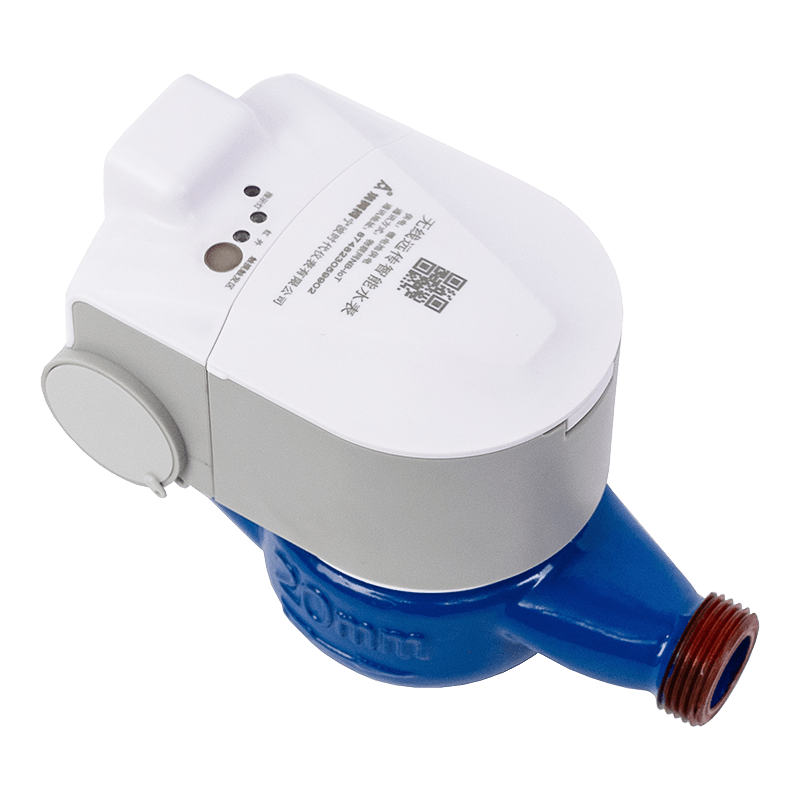 NB-IoT Wireless Water Meter with Integrated Valve ControlAn NB-IoT meter combining metering, data storage, valve control and prepaid functions, with copper, iron or stainless steel bodies and optional valves.View Product →
Valve control belongs in the same conversation. A meter that can close a valve remotely lets an operator act on non-payment, suspected leakage or an emergency isolation request without sending a crew. That capability has to be designed in from the start; it cannot be bolted onto a passive meter later.
Prepaid and card-based metering
Prepaid IC card meters shift collection risk away from the utility and towards the point of use, which is why they persist in rental housing, dormitories, serviced apartments and estate management. Bluetooth variants reduce the hardware needed at the point of sale, since a phone can handle the top-up. The trade-off is administration: someone has to manage tariffs, cards, refunds and exceptions, and the meter is only as good as the back office behind it.
Decide the reading method four steps before you decide the meter, because the communication choice determines what the meter must contain and how long it will stay in service.
Buying Flowmeters in Volume: What to Ask Before the Order
Price per unit is the number everyone compares and the number that predicts least about the final cost. For a utility or a contractor buying by the container, the questions below separate a supplier who can support a ten-year asset base from one who can fill a pallet.
- Who actually manufactures the measuring element? Assembly plants and manufacturers are different things, and the difference shows up in calibration consistency across batches.
- Can you supply type test reports and batch calibration certificates? Tender documents in many markets require them, and retrofitting paperwork after shipment rarely works.
- What is the MOQ and how stable is it? A manufacturer who can hold a repeatable MOQ across product families is easier to plan around than one who quotes a number and then revises it.
- Are units and dial markings fixed? Cubic metres and gallons versions must be ordered deliberately, and the register layout should match what field readers expect.
- What is the stated battery life and at which reporting interval? The two figures only mean something together.
- How are spare parts and replacement rotors handled? A meter range that cannot be serviced becomes landfill at the first failure.
- What is the packaging and pallet configuration? Shipping damage on brass bodies is a real cost, and it is decided by packaging rather than by freight terms.
- Can the range be mixed in one container? Ordering several sizes and functions together keeps stock aligned with installation schedules.
There is also the question of customisation. Many buyers want an OEM flowmeter branded for their utility, with a specific dial layout, a specific pulse factor, or a specific colour for the housing. That is a normal request for a manufacturer with its own tooling, but it changes lead time and minimum quantities, so it belongs in the first conversation rather than the last.
Finally, ask what the supplier does when something goes wrong. A wholesaler who can trace a batch, identify the production window and issue a replacement plan is worth a small premium over a broker who cannot. Instruments that sit in the ground for a decade generate support needs long after the invoice is paid.
The cheapest unit price is meaningless without batch consistency, calibration paperwork and a service route, because those three items decide the cost per metered year.
Installation and Field Maintenance That Protect the Reading
A correctly specified meter installed badly will still under-perform, and most of the failures that reach a service desk are installation issues rather than manufacturing defects. Straight lengths, strainers, orientation and commissioning checks cover the majority of them.
Installation points to get right
- Respect the upstream and downstream straight lengths in the manual. A meter directly after an elbow or a partly closed valve reads a distorted profile.
- Fit a strainer ahead of volumetric and turbine meters. Chamber jams and rotor wear both start with debris.
- Keep the pipe full and free of air pockets. Ultrasonic and electromagnetic meters are particularly sensitive to entrained air.
- Match mounting orientation to the model. Some designs are position-independent, others are not, and the difference is in the datasheet.
- Flush the line before commissioning and check the register against a measured volume where possible.
Maintenance that actually happens
Mechanical meters benefit from periodic verification rather than blind replacement. Pulling a sample batch every few years and testing it against a reference gives a realistic picture of how the population is ageing, and it usually shows that replacement should be targeted by water quality and flow profile rather than by calendar date alone.
Electronic meters need less mechanical attention but more data attention. Battery status, reporting gaps and valve operation should be monitored as part of the same routine, because a silent meter and an idle meter look identical in a dashboard until someone checks the last communication timestamp.
In cold climates, frost protection matters more than most datasheets admit. A meter in an exposed pit with no drainage will eventually split, and the resulting loss is often larger than the repair.
Installation quality and a light verification routine protect meter accuracy far more effectively than buying a higher specification than the application needs.
Frequently Asked Questions About Flowmeters
What is the difference between a water meter and a flowmeter?
In domestic and commercial water supply the terms overlap heavily. A water meter is a flowmeter built to legal metering standards, with a totaliser that records cumulative volume for billing. An industrial flowmeter may report instantaneous flow rate, may be built for process control, and may not carry metrological approval. If the reading ends up on a customer invoice, the device needs the appropriate accuracy class.
Which flowmeter is best for low residential flows?
Volumetric and positive displacement meters hold accuracy at very low flows because they capture discrete volumes rather than inferring flow from rotor speed. A well-specified multi-jet with a high turndown also performs well in ordinary households. The deciding factor is usually water quality, since chambers dislike grit.
How do I work out the right Q3 for a building?
Estimate peak simultaneous demand at that meter, multiply by roughly 1.3 to 2.0, and then check that the lowest realistic continuous draw stays above the meter's Q1. Verify pressure loss at Q3 against the available head before confirming the size.
Are ultrasonic flowmeters more accurate than mechanical meters?
They are more accurate across a wider range, particularly at low flows, and they add no obstruction to the pipe. Mechanical meters can be extremely accurate within their intended band and cost far less. The honest answer is that accuracy depends on the match between the meter and the flow profile rather than on the technology label.
What does the R value on a flowmeter mean?
The R value is Q3 divided by Q1, the turndown ratio. An R 160 meter with Q3 = 2.5 m³/h has a Q1 of about 15.6 litres per hour. A higher R means the meter keeps measuring accurately further down its range, which matters when consumption is small or highly variable.
Can a mechanical flowmeter be upgraded to remote reading?
Yes. Pulse output modules allow an external logger to collect consumption, and photoelectric direct reading modules read the register itself for a more audit-friendly record. Both are easier to specify at the point of purchase than to retrofit later, and neither is as capable as a purpose-built wireless meter with an integrated radio.
What maintenance do water flowmeters need?
Mechanical units need periodic verification, strainer cleaning and attention to frost and debris. Electronic units need battery monitoring, communication checks and valve testing where fitted. In both cases, sampling a batch and testing it against a reference tells you more than replacing on a fixed schedule.
How do I choose a flow meter supplier or wholesaler for a bulk order?
Look for a manufacturer with its own production and calibration capability, ask for type test reports and batch certificates, confirm MOQ stability, check that units and dial layouts are correct, and establish how spares and replacements will be handled. A supplier who can answer those questions in writing is generally a safer partner than one who competes only on unit price.
Do flowmeters work on hot water and heating circuits?
They do, but the temperature rating has to match the medium. Cold water meters placed on hot branches fog their dials and degrade their seals. Hot water variants and heat meters are built for continuous higher temperatures, and they should be specified as such rather than adapted afterwards.
Most FAQ questions come back to one idea: the meter must fit the water, the flow and the reading plan at the same time.
Where the Decision Usually Ends Up
For a residential utility, the pattern that works most often is a high-turndown mechanical meter with pulse or direct-reading output, specified at a Q3 that reflects real simultaneous demand rather than the largest pipe in the riser. For commercial and district applications, the electronic families earn their cost through wide measuring range, no obstruction in the bore and a communication path that removes manual reading rounds.
Both ends of that spectrum are covered by a manufacturer that builds the whole ladder, from multi-jet and volumetric mechanical units through Woltman mains meters to ultrasonic and wireless models, because the procurement conversation is easier when one supplier can be held to a consistent standard across product families.
Continue with the right next step
Useful starting points
Whichever route a project takes, the sequence stays the same: profile the flow, pick the principle, pin the specifications, then negotiate. Doing it in that order costs a little more time at the desk and considerably less money in the field.