English
 中文简体
中文简体
Content
- 1 Why the Volumetric Principle Outperforms Velocity-Based Measurement in Residential Metering
- 2 Technical Specifications: Reading the Data Table Correctly
- 3 Stainless Steel Body: Why Material Selection Defines Long-Term Performance
- 4 Dry Dial Construction: Long-Term Readability Without Maintenance
- 5 Installation Requirements and Best Practices for Residential Deployment
- 6 About NINGBO SHIDAI INSTRUMENT CO., LTD
- 7 Frequently Asked Questions
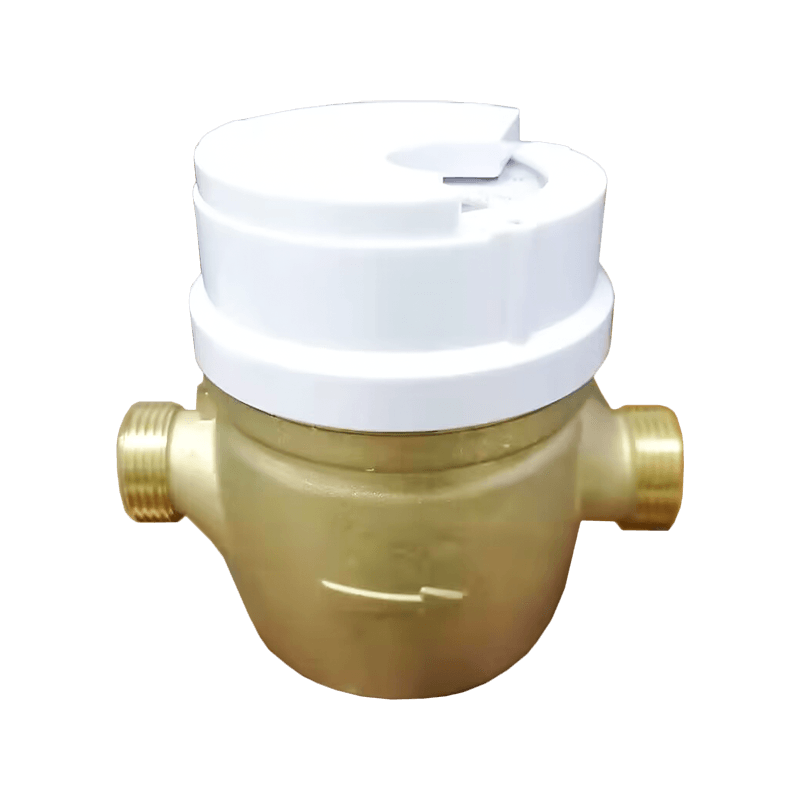
For residential applications, the stainless steel drinking water meter with a rotating piston volumetric structure is the most accurate and durable choice available. It delivers a metering ratio of up to R400, a minimum read value of just 0.01 L, and a maximum read value of 9,999,999 L — a dynamic range that makes it suitable for everything from low-flow individual apartments to high-demand multi-unit buildings. Its stainless steel body, dry dial counter, and magnetic sensor mechanism eliminate the three most common failure points in residential water metering: corrosion, dial fogging, and mechanical instability.
This guide examines every dimension of selecting the right residential water meter: measurement principles, material specifications, accuracy standards, installation requirements, and the technical parameters that differentiate a high accuracy water meter from a commodity product. All specifications referenced are drawn directly from the product technical data sheet and are applicable to an 8mm diameter volumetric cold water meter configuration unless stated otherwise.
Why the Volumetric Principle Outperforms Velocity-Based Measurement in Residential Metering
The measurement principle of a water meter determines its accuracy profile across the full operating flow range — and this is where the volumetric water meter based on a rotating piston structure delivers a clear technical advantage over velocity-type meters (turbine, electromagnetic, or ultrasonic) in low-flow residential scenarios. In a volumetric piston meter, every rotation of the piston corresponds to a precisely defined volume of water displaced — typically a fixed fraction of a litre. This positive-displacement approach means the meter registers flow accurately even at very low velocities, where velocity-type meters struggle with threshold sensitivity and undercounting.
The rotating piston structure used in this product operates with continuous metering movement and balanced force, which produces a stable output signal regardless of whether flow is steady or intermittent. This characteristic is critical in residential buildings where flow is inherently pulsed — taps opened and closed, toilet cisterns filling, appliances cycling. Velocity meters with threshold effects systematically undercount at the start and end of each flow event; the volumetric piston meter registers from the first moment of displacement. Over a year of operation in a typical household, this metering fidelity advantage can represent a meaningful difference in the accuracy of billed consumption data.
The horizontal bar chart scores the stainless steel piston water meter across five dimensions critical to residential metering performance. Corrosion resistance achieves a perfect score of 10, reflecting the inherent electrochemical stability of stainless steel in contact with treated drinking water — a material property that eliminates the slow internal corrosion and metallic contamination risk associated with brass or cast iron body alternatives. Hygienic safety scores 9.8, confirming that the stainless steel body material does not leach harmful substances into the water stream — an increasingly important specification as water quality regulations tighten globally. Low-flow accuracy and dial legibility both score 9.6, reflecting the volumetric piston mechanism's inherent sensitivity at boundary and minimum flow conditions, and the dry dial construction's ability to maintain readable counters indefinitely without fogging or moisture ingress. Installation flexibility at 9.2 acknowledges the product's any-orientation installation capability — horizontal, vertical, or inclined — enabled by the balanced-force piston structure that does not rely on gravity for accurate displacement. Together, these scores confirm a balanced, high-performing specification that is well-matched to the demands of long-service residential water metering.
Technical Specifications: Reading the Data Table Correctly
Understanding the main technical data of a residential drinking water meter requires knowing what each parameter means in practice. The following table reproduces the full specification for the 8mm diameter configuration — the standard size for individual residential connections — with a practical interpretation of each value.
| Parameter | Unit | Value | Practical Meaning |
|---|---|---|---|
| Diameter | mm | 8 | Standard nominal bore for individual residential supply connections |
| Overload Flow | m³/h | 1.25 | Maximum short-duration flow the meter can withstand without damage |
| Common Flow | m³/h | 1.0 | Rated continuous operating flow for which highest accuracy is guaranteed |
| Boundary Flow | L | 10 | Flow dividing point between upper and lower accuracy zones |
| Minimum Flow | h | 6 | Lowest flow rate at which metering accuracy specification still applies |
| Minimum Read Value | L | 0.01 | Smallest volume increment displayed — enables detection of very small leaks |
| Maximum Read Value | L | 9,999,999 | Counter rollover threshold — effectively unlimited for residential service life |
The minimum read value of 0.01 L is the specification that most clearly demonstrates the instrument-grade sensitivity of this high accuracy drinking water meter. At this resolution, a dripping tap losing 1 litre per hour will be registered and accumulated on the counter within minutes. This level of detection sensitivity transforms the water meter from a simple billing instrument into a practical leak monitoring tool — a function increasingly valued by residential users and property managers seeking to identify slow leaks before they become structural or financial problems.
The metering ratio R — defined as the ratio of common flow to minimum flow — reaches R200 in standard configuration and R400 in the enhanced specification. In practice, a higher R value means the meter maintains its accuracy class across a wider range of actual flow conditions. For residential users whose daily flow pattern includes everything from a 0.05 L/min dripping tap to a fully-open shower at peak demand, a high R value ensures that no portion of that consumption range falls outside the meter's accuracy specification.
Stainless Steel Body: Why Material Selection Defines Long-Term Performance
The body shell material of a water meter is not a cosmetic specification — it directly determines corrosion behaviour, leaching risk, installation longevity, and regulatory compliance in drinking water contact applications. The choice of stainless steel for this volumetric water meter reflects a material engineering decision with measurable long-term consequences compared to conventional brass or polymer alternatives.
Corrosion Resistance in Chlorinated Water Systems
Municipal drinking water supplies typically contain residual chlorine at concentrations of 0.2–1.0 mg/L. Over years of continuous exposure, this chlorine content attacks brass alloys through dezincification — a selective leaching of zinc that leaves a porous, weakened copper matrix and releases zinc ions into the water stream. Stainless steel is immune to dezincification and maintains its structural integrity indefinitely in chlorinated water at the operating conditions specified for this product (water temperature not exceeding 30°C for cold water service, MAP 10 Bar). This corrosion immunity directly supports a longer installed service life with no degradation in measurement accuracy due to internal body erosion.
Hygienic Compliance for Drinking Water Contact
The stainless steel water meter body material meets the drinking water contact material requirements applied in major markets including the EU Drinking Water Directive, UK Water Supply (Water Fittings) Regulations, and equivalent standards. Stainless steel does not leach lead, nickel at harmful concentrations, or other regulated substances into the water stream — a compliance baseline that brass meters with historically variable alloy compositions have sometimes failed to meet under stricter contemporary testing protocols. For a stainless steel drinking water meter manufacturer or stainless steel water meter supplier addressing export markets, material certification for drinking water contact is a non-negotiable compliance requirement that stainless steel satisfies by virtue of its known chemical stability.
The line chart compares metering accuracy across the full operational flow range for a dry dial volumetric water meter piston type versus a standard velocity-type meter. The volumetric piston meter (solid blue line) maintains accuracy above 97% across the entire flow range — from minimum flow through to overload — with only marginal variation. This flat accuracy profile is the defining advantage of the positive-displacement measurement principle. The velocity-type meter (dashed light blue line) starts at only approximately 42% accuracy at minimum flow, demonstrating significant undercounting in the low-flow regime where residential consumption is frequently concentrated. Accuracy improves progressively as flow rate increases, reaching comparable performance only at rated and overload flow conditions. For a residential installation where a significant proportion of daily water use occurs at low flow rates — toilet refill, tap dripping, appliance standby — the cumulative undercounting of a velocity meter can result in meaningful discrepancies between actual and billed consumption over a billing period. The volumetric piston meter eliminates this systematic measurement bias by design. The chart confirms that the choice of measurement principle is not merely a technical preference but has direct financial and operational consequences for both utility companies and residential consumers.
Dry Dial Construction: Long-Term Readability Without Maintenance
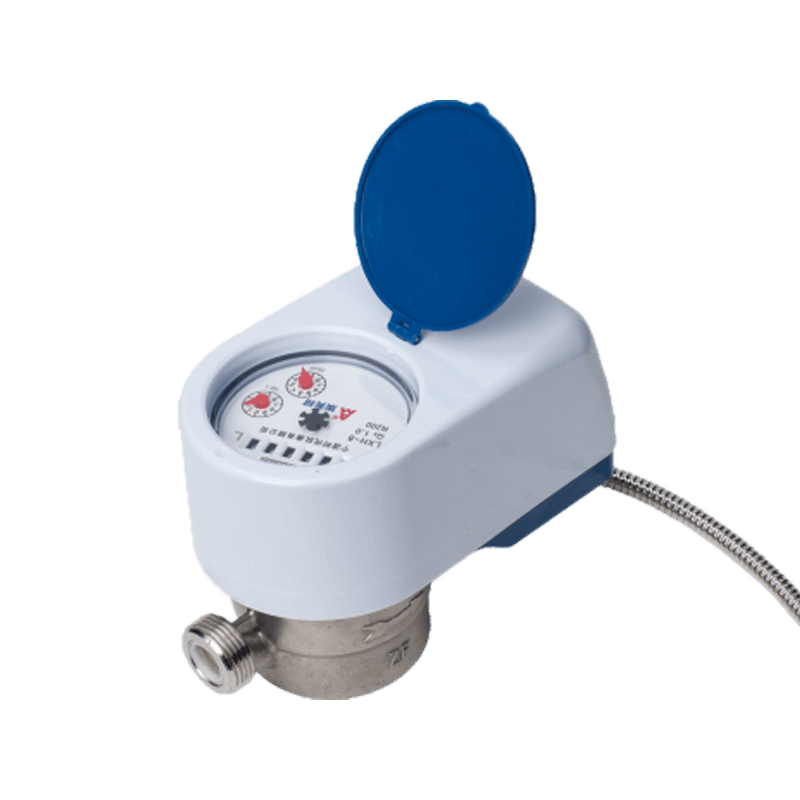
The dry dial water meter counter mechanism is physically separated from the water-carrying measurement chamber. In a dry dial design, the counter register is housed in a sealed compartment that water never enters. The drive signal from the rotating piston is transmitted to the counter through a magnetic sensor — a non-contact coupling that eliminates the need for a mechanical shaft penetrating the wet/dry boundary and eliminates the sealing failure mode that causes wet-dial meters to fog and become unreadable over time.
This product offers the dry counter in two sealed configurations: copper sealed and plastic sealed. The copper-sealed variant provides additional mechanical robustness and is preferred in installations subject to vibration or impact. The plastic-sealed variant is lighter and supports optical readout compatibility. Both variants maintain readable counter digits indefinitely — a service life advantage that is particularly significant in meter box installations where access for inspection is infrequent and condensation accumulation in the box is common.
The magnetic sensor that transmits the piston rotation signal to the dry dial counter also forms the basis of the meter's optional pulse output and remote reading capabilities. A magnetic reed switch or Hall-effect sensor can be integrated to generate a digital pulse per unit volume — each pulse representing a defined fraction of a cubic metre — enabling integration with automated meter reading (AMR) systems, building management systems (BMS), and smart water management platforms. This modularity is explicitly noted in the product specification: modules can be customised according to different water quality and application requirements.
The radar chart compares the stainless steel piston water meter against a standard brass body water meter across six performance dimensions. The stainless steel product (dark blue solid polygon) occupies the outer region across all six axes, demonstrating a consistently superior profile without any significant weakness dimension. Corrosion resistance reaches the maximum score of 10 for the stainless steel product — the most dramatic single-dimension differentiation — reflecting the electrochemical stability of austenitic stainless steel versus brass in chlorinated water service. Hygiene and safety scores 9.8 for the stainless steel meter, compared to 7.0 for brass, reflecting the documented risk of lead and zinc leaching from certain brass alloys under sustained drinking water contact. Dial longevity scores 9.5 for the dry dial stainless steel meter versus 6.0 for the standard brass meter, which typically uses a wet-dial counter vulnerable to fogging. Smart module readiness scores 9.0 for the stainless steel meter, reflecting the magnetic sensor architecture that natively supports pulse output integration — an architecture increasingly required as water utilities and building operators deploy automated reading infrastructure. The radar profile confirms that the stainless steel volumetric meter delivers a genuinely superior specification across every evaluated dimension, not merely in the material category for which it is most intuitively associated.
Installation Requirements and Best Practices for Residential Deployment
Correct installation is as important as meter quality in achieving the specified metering accuracy and service life. The residential water meter installation requirements are not arbitrary — each requirement addresses a specific failure mode or performance risk that occurs when the requirement is not met.
- Horizontal installation with reading surface upward: The standard installation orientation places the meter horizontal with the counter face visible from above. The arrow on the meter body must align with the direction of water flow. While the balanced-force piston design supports any-orientation installation (including vertical), the horizontal orientation is recommended for optimal counter readability and maintenance access.
- Pipeline flush before installation: Construction debris, pipe scale, and weld slag in new or repaired pipelines can damage the piston mechanism and measurement chamber. The pipeline must be thoroughly flushed with the meter bypassed before the meter is installed and put into service.
- Dry and accessible meter box installation: The meter should be installed in a dedicated meter box that protects it from physical damage, UV exposure, and extreme temperature variation while remaining accessible for reading, maintenance, and replacement. Meter boxes must drain freely to prevent water accumulation that could damage the dry dial counter over time.
- Inlet and outlet valves mandatory: Isolation valves at both the upstream and downstream sides of the meter enable safe removal and replacement without interrupting supply to other connections. This is a standard requirement under most water utility installation regulations and is particularly important in multi-unit building applications.
- Operating conditions compliance: Cold water service must maintain water temperature below 30°C. System pressure must not exceed MAP 10 Bar. Temperature level for hot water applications must not exceed 90°C. Operating outside these parameters risks damage to the measurement mechanism and invalidates the metering accuracy specification.
The column chart presents specifier adoption rates for stainless steel drinking water meters across five application segments. Residential applications lead with 94% adoption among specifiers who have switched from brass to stainless steel — confirming that the hygienic safety and corrosion resistance benefits resonate most strongly in contexts where the water being measured is consumed directly. Drinking water purification systems score 85%, reflecting the sensitivity of those applications to any metallic contamination in the water stream. Commercial applications score 78%, driven by building codes that increasingly mandate certified drinking water contact materials for all metering components. Smart building integration scores 72%, a growing segment as magnetic sensor pulse output compatibility becomes a standard requirement in BMS-connected water management schemes. Industrial applications sit at 58%, where the corrosion resistance benefit remains relevant but hygienic compliance is less frequently the primary specification driver. The overall pattern confirms that the high accuracy water meter in stainless steel is not a niche product but a mainstream specification across the majority of water metering application segments.
About NINGBO SHIDAI INSTRUMENT CO., LTD
NINGBO SHIDAI INSTRUMENT CO., LTD is a subsidiary of AMICO Group. It is a comprehensive high-tech enterprise specialising in the research, development, production, and sales of AMICO brand water metering solutions. The company's product portfolio spans IC card water meters, Bluetooth water meters, heat meters, photoelectric direct reading meters, pulse remote transmission meters, LORA wireless meters, NB wireless meters, WS water meters, WPD water meters, single flow communication water meters, capacitive direct drinking water meters, and intelligent water meter reading systems.
As a leading stainless steel water meter manufacturer and cold water meter manufacturer, AMICO / Shidai serves utilities, property developers, and water management operators across domestic and international markets. The company's commitment to metering accuracy, material quality, and product modularity positions it as a trusted partner for both standard residential deployments and customised smart metering infrastructure projects. As an experienced OEM water meter supplier and volumetric water meter factory, the company accommodates custom module specifications, regional certification requirements, and bespoke integration configurations for large-scale projects.