English
 中文简体

Content
- 1 What the Conductivity of Water Actually Measures
- 2 Typical Conductivity Ranges Across Water Sources
- 3 Reading Those Ranges on a Single Scale
- 4 Why Conductivity Changes Which Meter You Should Specify
- 5 Matching Meter Families to Conductivity and Water Chemistry
- 6 How to Measure Conductivity in the Field Without Fooling Yourself
- 7 Conductivity, Scale and Long-Term Billing Accuracy
- 8 What Distributors and Wholesalers Should Confirm Before Ordering
- 9 Misunderstandings That Cost Money
- 10 Frequently Asked Questions About Water Conductivity
- 10.1 What is a normal conductivity for drinking water?
- 10.2 Does high conductivity damage a water meter directly?
- 10.3 Can I use an electromagnetic water meter on pure or deionized water?
- 10.4 Is conductivity the same as TDS?
- 10.5 Why does my conductivity reading change during the day?
- 10.6 Does a water softener lower conductivity?
- 10.7 How often should meters be verified in hard water?
- 10.8 Which unit should appear in a specification?
- 11 Continue Reading
A utility engineer takes a beaker from a district where the groundwater runs through limestone, drops in a handheld probe, and reads 1,180 µS/cm. Eighteen months later, a sample of the mechanical meters from that same district sits on the test bench reading 3 to 6 percent low. Nothing was defective when those meters left the factory. The water simply left mineral behind on every surface it touched, including the inside of the measuring chamber.
That is the short answer to why the conductivity of water matters to anyone who buys, sells or specifies water meters. It does not change how much water flows through a pipe, but it changes what that water does to the meter over the next five years. Conductivity is the fastest and cheapest proxy for dissolved mineral load, and dissolved mineral load drives scale, corrosion and long-term drift.
The sections below work through the numbers you are likely to see on site, what they mean at the specification stage, and how to line up meter families, from multi-jet and volumetric models through ultrasonic, electromagnetic and photoelectric units, against the water chemistry in front of you. The focus stays on decisions rather than definitions, because a meter that is technically correct but chemically mismatched will still fail early.
What the Conductivity of Water Actually Measures
In plain terms, conductivity describes how easily a water sample carries an electrical current. Pure H2O is a very poor conductor. The current is carried almost entirely by dissolved ions, chiefly calcium, magnesium, sodium, potassium, bicarbonate, sulphate and chloride. The more of these ions are present, the higher the reading, and the reading is essentially a headcount rather than a roll call.
Numbers usually appear in microsiemens per centimetre (µS/cm) or millisiemens per centimetre (mS/cm), where 1 mS/cm equals 1,000 µS/cm. Because ion mobility rises with heat, readings are normally referenced to 25 °C. An uncompensated probe drifts by roughly 2 percent per degree Celsius, which is enough to make a summer sample and a winter sample from the same pipe look like two different water sources.
A rough conversion to total dissolved solids (TDS) is to multiply the conductivity in µS/cm by 0.5 to 0.7 to land in milligrams per litre. That factor is exactly why TDS pens and conductivity meters share the same sensing principle, and why a TDS figure quoted to three decimal places usually overstates its own precision.
- It gives a quick total dissolved ion load, useful for screening a new supply before a meter is ordered.
- It responds to seawater intrusion, road salt, fertilizer runoff and industrial discharge, which is why environmental monitoring programmes lean on it as a first-pass indicator.
- It does not identify which ions are present, and two supplies at the same conductivity can behave very differently inside a measuring chamber.
- It does not measure bacteria, pesticides, organic matter or turbidity, so it is never a substitute for a full potability panel.
- It correlates with hardness in most groundwater, but the correlation breaks down in softened or sodium-rich supplies.
The last three points carry real commercial weight. A distributor who quotes a meter on conductivity alone may miss chloride, silica or free carbon dioxide, all of which can be harder on a chamber, a piston or a brass body than the total ion count suggests. Conductivity is the entry point to the conversation, not the conclusion.
Conductivity is a total-ion number, not a water-quality verdict: it predicts how much dissolved mineral a meter will see, not whether the water is safe to drink.
Typical Conductivity Ranges Across Water Sources
Field engineers rarely need a textbook definition. They need to know whether the number in front of them sits in an ordinary band or an unusual one. The table below collects the ranges that come up most often during pre-sales checks, together with the practical implication for metering.
| Water type | Typical conductivity at 25 °C | What it usually means for metering |
|---|---|---|
| Ultrapure and deionized water | 0.05 to 5 µS/cm | Almost no ions, so electromagnetic sensing will not work; the risk shifts from scale to aggressive low-solids corrosion |
| Distilled water | 0.5 to 5 µS/cm | Often used as a reference fluid; unsuitable for induction-based meters |
| Reverse osmosis permeate | 5 to 50 µS/cm | Low but not zero; always confirm the sensor's minimum conductivity before specifying |
| Rainwater and harvested supply | 10 to 50 µS/cm | Low mineral load, but acidity and dissolved gas vary widely and affect body materials |
| Softened municipal water | 200 to 500 µS/cm | Sodium replaces calcium, so the count barely moves while scale risk falls and chloride rises |
| Typical drinking water | 200 to 800 µS/cm | The comfortable band for most mechanical and ultrasonic meters |
| Hard groundwater | 500 to 1,500 µS/cm | Deposit control and verification intervals deserve attention from day one |
| Rivers and streams | 50 to 1,000 µS/cm | Seasonally variable; snowmelt and storm events move the number quickly |
| Brackish water | 1,500 to 15,000 µS/cm | Corrosion and deposit management both matter; material selection dominates the decision |
| Seawater | around 50,000 µS/cm | Aggressive chloride load; stainless steel and suitable engineering plastics over brass |
Two entries in that table cause more specification errors than the rest. The first is softened water. A softener swaps calcium and magnesium for sodium, so the ion count stays almost unchanged while the scale risk drops sharply. A buyer who rejects a meter because the conductivity is still 450 µS/cm after softening has misread the number. The second is reverse osmosis permeate, which sits far below the operating floor of induction-based sensors yet remains perfectly serviceable for mechanical and transit-time ultrasonic designs.
Seasonality deserves its own note. In networks fed by surface water, conductivity can swing by a factor of two or three between a dry autumn and a spring snowmelt. A single sample taken in March may not represent the water that passes through the meter in August, and in supply networks with blending or borehole switching, the variation can be larger still.
Most residential and light commercial supplies sit between 200 and 800 µS/cm, which is exactly the band where mechanical meters remain economical and ultrasonic meters earn their premium.
Reading Those Ranges on a Single Scale
A table is precise but hard to compare at a glance, because the spread from ultrapure water to seawater covers roughly six orders of magnitude. The horizontal chart below compresses that spread onto a logarithmic scale so the low-conductivity end stays visible next to the seawater end.
For meter selection, that chart is really a map of risk. Anything to the left of RO permeate rules out induction-based electromagnetic sensing and pushes the conversation toward mechanical or transit-time ultrasonic designs. The middle band, roughly 200 to 800 µS/cm, is where most AMICO multi-jet, single-jet and volumetric models spend their working lives, and it is also where ultrasonic meters start to make commercial sense for utilities chasing low-flow accuracy.
Move further right and the priority shifts from accuracy to materials. Above roughly 1,500 µS/cm, chloride usually arrives alongside the calcium, and chloride is the ion that decides whether a brass body lasts fifteen years or seven. Seawater sits so far off the right-hand edge that the discussion is almost never about measurement principle anymore, but about stainless steel, engineering plastics, sealing compounds and the frequency of field verification.
Presented this way, the chart also explains why a single conductivity figure is not enough for a tender document. Two supplies reading identical values can sit at opposite ends of the hardness and chloride spectrum, which is why serious specifications pair conductivity with a hardness figure, a chloride figure and a temperature range.
The position of a supply on this scale decides the measurement principle first, the body material second and the verification interval third.
Why Conductivity Changes Which Meter You Should Specify
Scale forms where dissolved ions meet heat
Calcium and magnesium bicarbonate are the usual suspects. Below roughly 300 µS/cm in a cold supply, deposit growth is slow enough that a meter may complete a full verification cycle without measurable drift. Above 700 µS/cm, particularly where the water is warmed in a hot-water loop or a boiler feed, calcium carbonate can begin to lay down a film on chamber walls, piston surfaces and impeller pivots within a couple of years. A film of a few hundredths of a millimetre is enough to change clearances in a volumetric chamber.
Corrosion follows the ion mix, not just the count
High conductivity with a chloride-heavy profile attacks brass and some copper alloys, while low conductivity with dissolved carbon dioxide and oxygen can be surprisingly aggressive in a different way. That is why a stainless steel body or a plastic body often justifies its price premium in coastal networks and demineralized loops, even where the headline conductivity number looks unremarkable.
Sensor-based meters have a conductivity floor
Electromagnetic meters generate a signal from the motion of ions through a magnetic field. No ions means no signal. Suppliers commonly quote a minimum conductivity around 5 µS/cm, and many prefer 20 µS/cm or more before they will guarantee accuracy across the full flow range. On RO permeate, deionized loops or condensate lines, that floor rules the technology out, no matter how good the meter is on paper.
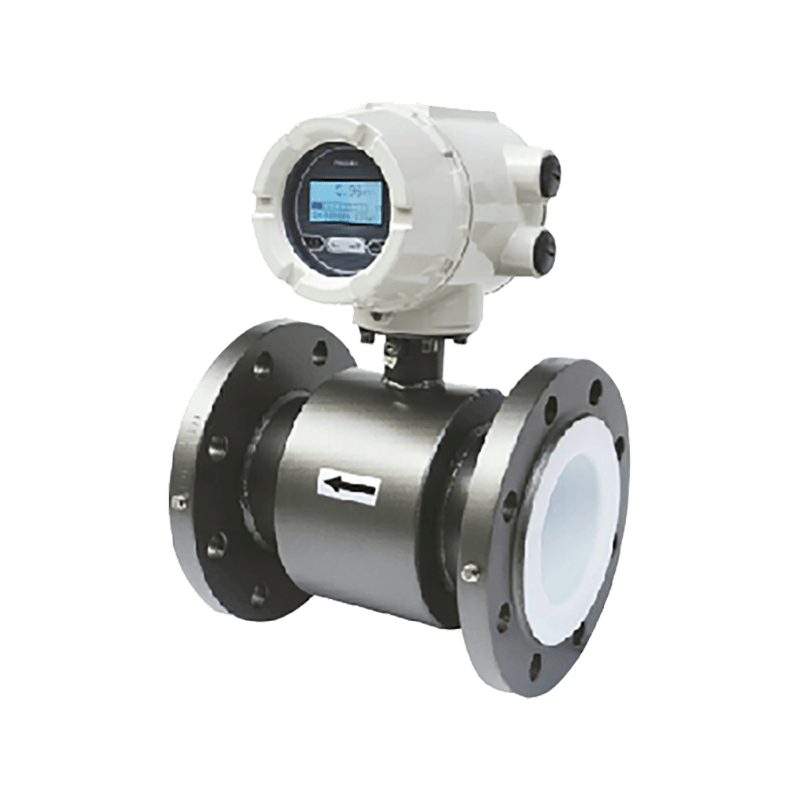 Electromagnetic Water Meter for High-Precision Bidirectional Flow MeasurementView this electromagnetic meter for high-accuracy bidirectional measurement, ultra-low starting flow, IP68 protection, and communication options suited to DMA partitioning.View Product →
Transit-time ultrasonic meters work on a different principle and are far less dependent on ion content, which is why they often appear where electromagnetic designs cannot. The trade-off is that ultrasonic accuracy depends on a clean acoustic path, so scale on transducer faces and reflectors becomes the limiting factor instead of conductivity itself.
Check the minimum conductivity of any sensor-based meter before the tender is written, because no amount of installation quality can overcome a fluid that carries too few ions.
Matching Meter Families to Conductivity and Water Chemistry
Multi-jet and single-jet meters
Dry-dial multi-jet meters tolerate a wide band, typically from about 100 to 1,500 µS/cm, without complaint, because the water only touches the chamber, the impeller and the strainer. In hard water the practical weak points are the strainer and the impeller pivot rather than the register. Single-jet designs are simpler and cheaper, well suited to household metering on stable municipal supply, and their straight, single-pass flow path is somewhat easier to flush after a deposit problem.
Volumetric meters
Piston and rotary-piston chambers deliver the best low-flow accuracy among mechanical families, and that is precisely where scale does the most damage, because a thin film on the cylinder wall changes the swept volume. On supplies above about 800 µS/cm, a volumetric meter is still a sound choice provided it is protected by a proper strainer, checked at agreed intervals and, where the chemistry allows, specified with a body material that will not corrode.
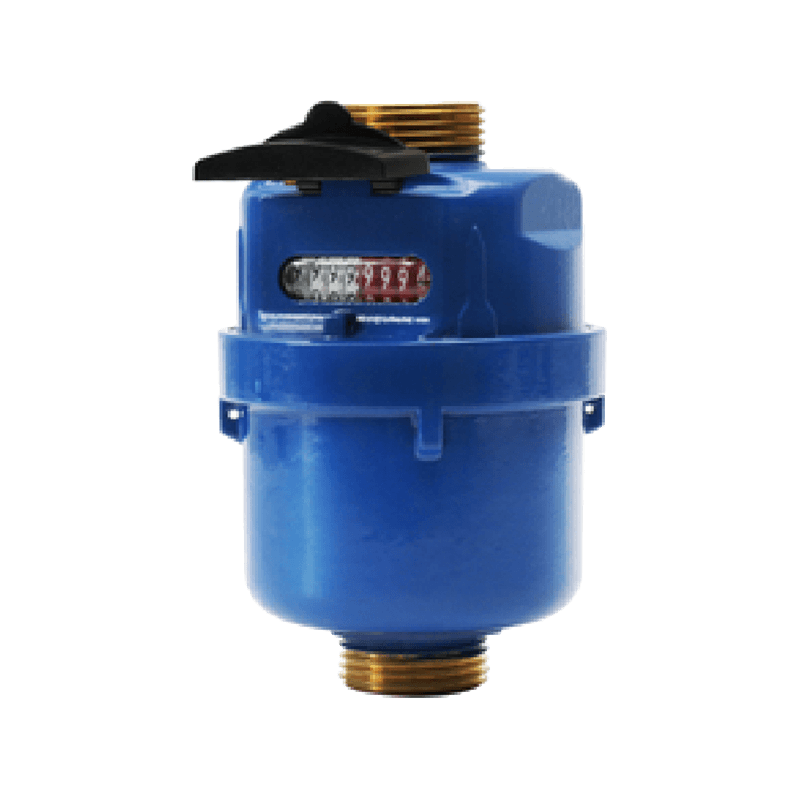
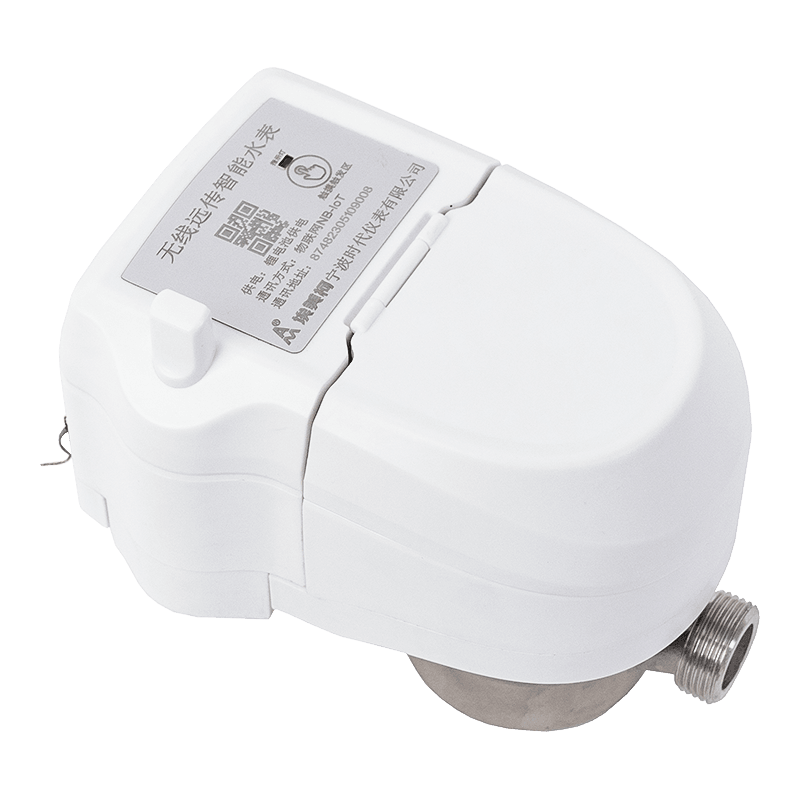 Stainless Steel Volumetric Drinking Water MeterA rotating-piston volumetric meter with stainless steel body, low initial flow and high accuracy, suited to drinking water lines where corrosion resistance matters.View Product →
Stainless steel construction removes one failure path in drinking water applications where chloride and dissolved oxygen vary through the year. It also holds up better than brass in softened supplies, where sodium and chloride remain in the water long after the hardness has been exchanged out.
Woltman and detachable meters
Large-diameter mains usually make the conductivity question secondary to debris, flow profile and straight-pipe requirements. Where the supply is brackish, however, material choice returns to the front of the queue, and the difference between a coated body and a bare one shows up in the maintenance log rather than in the datasheet.
Ultrasonic meters
Transit-time ultrasonic meters hold low-flow accuracy without moving parts and cope with conductivity values that would defeat an electromagnetic design. Their weakness is the acoustic path itself: scale on transducer faces, reflectors and the inner wall gradually reduces signal strength. In water above roughly 800 µS/cm, protect the installation with an upstream strainer, record signal quality at commissioning, and treat any drop in signal strength as an early warning rather than a nuisance alarm.
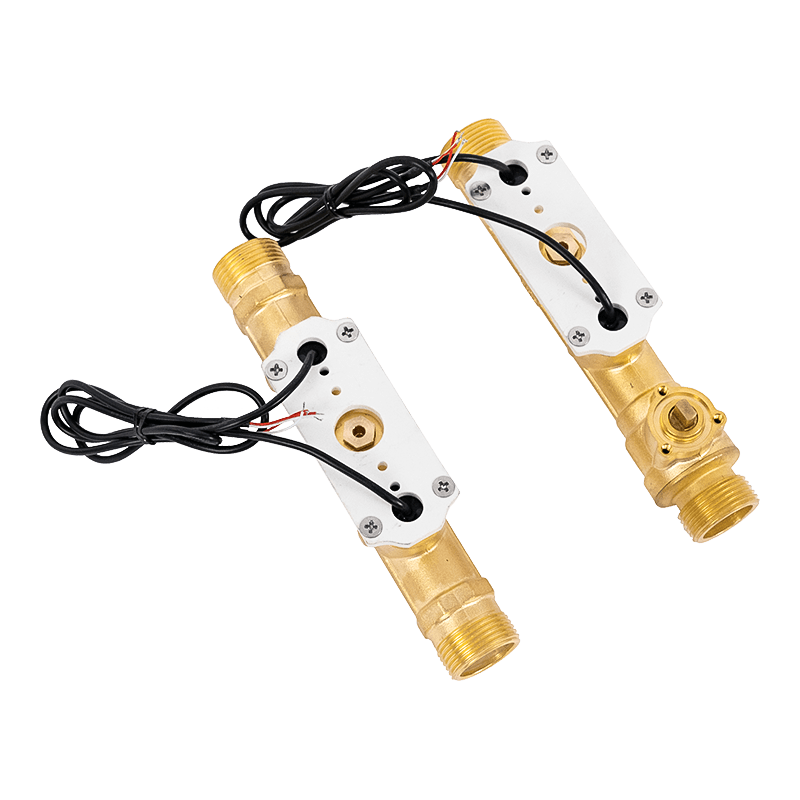 Ultrasonic Water Meter for Low-Flow Cold Water MeasurementTime-difference ultrasonic meter with no moving parts, low initial flow, R≥250 and remote-reading interfaces for cold-water pipeline totalizing.View Product →
For a detailed look at how this family behaves at the bottom of the flow range, our engineering note on the key advantages of ultrasonic meters over mechanical designs walks through the comparison in practical terms.
Photoelectric direct-reading meters
Direct-reading registers solve the reading problem, not the water problem. Where conductivity is high, the risk moves to the dial glass and the optical window, because a mineral film scatters light and produces recognition errors long before the measuring chamber drifts. Regular cleaning during the verification visit handles most of this, and a sealed optical chamber with a wiper or anti-fog treatment handles the rest.
Match the measuring principle to the ion content first, then choose body material and verification intervals to suit the hardness and chloride profile.
How to Measure Conductivity in the Field Without Fooling Yourself
Most bad conductivity numbers come from technique rather than instruments. A handheld water conductivity meter costing very little will outperform an expensive probe used carelessly, and the reverse is also true. The sequence below is the one worth training field staff on.
- Rinse the sample cup and the probe twice with the water being tested, then fill the cup and let it stand briefly so bubbles can escape.
- Check calibration against a standard solution close to the expected range, typically 1,413 µS/cm for drinking water work and 84 µS/cm for low-conductivity loops.
- Confirm the temperature compensation setting and record the actual water temperature alongside the reading, because a compensated figure without a temperature note is only half a result.
- Take the sample after a short flush from a flowing tap or a dedicated sampling point, never from a dead leg or a strainer housing that has been sitting full for weeks.
- Log the reading with the date, the sampling point and the supply source, so seasonal variation becomes visible instead of surprising.
Inline conductivity sensors are worth considering where the same supply feeds a boiler house, a RO plant or a district metering area. They turn a one-off number into a trend, and trends are what tell a maintenance team whether a meter drifted because of water chemistry or because of a mechanical fault.
For utilities running large networks, it also helps to test conductivity at the same time as flow and pressure, using the same visit. The marginal cost of an extra two minutes is small compared with a second site visit, and the combined record makes later warranty discussions far more productive.
Record conductivity together with temperature, sampling point and date, because an isolated number without context cannot support a specification or a warranty claim.
Conductivity, Scale and Long-Term Billing Accuracy
The commercial damage from scale is subtle. Deposits on a chamber wall reduce the swept volume slightly, so the meter under-registers; deposits on an impeller add drag and produce the same direction of error. Either way, the utility sells less water than it supplies, and the loss grows quietly until someone runs a bench test.
Accuracy classes under ISO 4064 and OIML R49 allow a tolerance in the lower zone and a tighter tolerance in the upper zone, and a new meter typically sits comfortably inside both. The problem is the drift after installation. In soft, low-conductivity water, a well-made mechanical meter may hold its calibration for a full five-year cycle. In hard water above 800 µS/cm, meaningful drift can appear within two to three years, and the drift is not linear, which makes it hard to correct afterwards.
| Conductivity band | Typical deposit risk | Practical verification interval |
|---|---|---|
| Below 100 µS/cm | Low mineral load; watch for low-solids corrosion instead | 5 years or per local metrology rule |
| 100 to 400 µS/cm | Low to moderate, hardness dependent | 4 to 5 years |
| 400 to 800 µS/cm | Moderate where hardness is high | 3 to 4 years |
| 800 to 1,500 µS/cm | Moderate to high in hard groundwater | 2 to 3 years |
| Above 1,500 µS/cm | High; scale and chloride act together | 2 years, with in-service spot checks |
Smart meters change the economics of this table. A remote-reading meter that reports a falling minimum night flow or an unusual consumption pattern gives the utility an early signal that something has changed at the endpoint. That signal can prompt a targeted verification instead of a blanket replacement programme, which is far cheaper across a large installed base.
Valve-equipped models deserve a separate mention. A scaled valve seat may not close fully after a few years in hard water, and a valve that leaks slightly is worse than no valve at all in a prepaid or credit-control scheme. Where conductivity suggests heavy deposit risk, specify the valve body material with the same care as the measuring chamber.
In hard water, shortening the verification interval is usually cheaper than absorbing several years of silent under-registration.
What Distributors and Wholesalers Should Confirm Before Ordering
Buyers sourcing meters for a portfolio of projects rarely have the luxury of testing every site. A short, disciplined checklist closes most of the gap, and it also separates a serious water meter manufacturer from a trading company that simply relabels cartons.
- The conductivity range across the whole year, not just the design figure, plus a hardness and chloride reading from the same sample.
- The water temperature range, including any hot-water or boiler-loop application, because heat accelerates deposit formation sharply.
- Nominal diameter, permanent and overload flow rates, and the pressure loss the network can tolerate at peak demand.
- Metering principle and its conductivity floor, especially where RO, deionized or condensate water is involved.
- Body and internal material, sealing compounds and the expected service life under the stated chemistry.
- Communication protocol where remote reading is required, plus battery life expectations and valve control if prepayment is planned.
- Certification and test documentation, including the accuracy class claimed and the standards the meter is tested against.
- Production capacity, lead time and spare-parts availability, which matter as much as unit price once a project enters its second phase.
It also helps to ask how the supplier's own testing is structured. A factory that controls incoming materials, component machining, performance testing and final packaging under one quality system can usually answer technical questions with data rather than assurances. Ningbo Times Instrument Co., Ltd., the manufacturer behind the AMICO range of smart water meters, has been building meters since 2001 across a 12,000 square metre production site with more than 140 staff and over 1,000 completed projects, which is the kind of background a wholesaler can verify during a factory visit.
Portfolio breadth is another practical consideration. A supplier whose catalogue covers multi-jet, single-jet, volumetric, Woltman, photoelectric, prepaid IC card, wireless and ultrasonic families lets a distributor answer a hard-water tender and a low-conductivity industrial enquiry from one source, with consistent documentation and a single point of technical contact.
Ask for the water chemistry and the testing records together, and the specification conversation stops being a guessing game.
Misunderstandings That Cost Money
- Pure water conducts electricity well. It does not. Ultrapure water sits near 0.055 µS/cm and is a good insulator; the conductivity people see in ordinary supplies comes entirely from dissolved ions.
- Higher conductivity means unsafe water. Seawater reads around 50,000 µS/cm and is not a contamination event. Conductivity is an indicator of dissolved solids, not a toxicity test.
- Conductivity equals hardness. They usually travel together in groundwater, but a softener breaks the link by exchanging calcium for sodium while leaving the ion count much the same.
- A TDS pen is a different instrument. Most handheld TDS meters measure conductivity and apply a fixed conversion factor, so the underlying principle is identical.
- Conductivity is irrelevant to meter choice. It sets the measurement principle at the low end, the deposit risk at the high end and the verification interval in between.
Each of these misunderstandings shows up in real tender documents. The softened-water case is the most expensive, because a buyer who rejects an appropriate meter on the basis of a 450 µS/cm reading may end up specifying an over-engineered unit for every dwelling in the project.
Treat conductivity as one input among four, alongside hardness, chloride and temperature, and most specification errors disappear before the order is placed.
Frequently Asked Questions About Water Conductivity
What is a normal conductivity for drinking water?
Most municipal supplies fall between 200 and 800 µS/cm, and many bottled mineral waters sit between 300 and 1,000 µS/cm. Values outside that band are not automatically a problem, but they are worth explaining, because taste becomes noticeably flat below roughly 100 µS/cm and salty above about 1,000 µS/cm.
Does high conductivity damage a water meter directly?
Not directly. The meter does not respond to the current-carrying capacity of the water. Damage comes from the ions responsible for the reading, through carbonate scale on chamber surfaces and through chloride-driven corrosion of brass components. That indirect path is why conductivity is a useful predictive number rather than a direct cause.
Can I use an electromagnetic water meter on pure or deionized water?
No. Induction-based meters need a minimum ion concentration to generate a measurable signal, typically around 5 µS/cm and preferably 20 µS/cm or more. On RO permeate, condensate or deionized loops, choose a mechanical or transit-time ultrasonic design instead.
Is conductivity the same as TDS?
They are proportional rather than identical. TDS is estimated by multiplying conductivity by a factor usually between 0.5 and 0.7, and that factor changes with the ion mix. For compliance reporting, use the method your regulator specifies rather than a generic conversion.
Why does my conductivity reading change during the day?
Temperature is the usual reason. Without temperature compensation, a reading taken from a storage tank in the afternoon can be 15 percent higher than the same water sampled at dawn. Blending, borehole switching and treatment cycles can also move the number, which is why sampling time should be recorded.
Does a water softener lower conductivity?
Barely. Softening exchanges calcium and magnesium for sodium, and the total ion count stays close to what it was, so the reading may even rise slightly. What really falls is the scale risk, which is why softened supplies should be judged on hardness and chloride rather than conductivity alone.
How often should meters be verified in hard water?
In supplies above 800 µS/cm, a two to three year verification interval is a reasonable starting point, shortened further where temperature is high or the chloride load is heavy. Low-conductivity supplies can often stretch to four or five years, subject to whatever the local metrology authority requires.
Which unit should appear in a specification?
Microsiemens per centimetre at 25 °C is the most widely understood form. State the reference temperature, the expected range across the year and the sampling method, because a specification that quotes a single value without those details leaves the supplier guessing.
Continue Reading
Two engineering notes take the low-flow side of this topic further: one compares sensing principles where accuracy at small flows decides revenue, and the other explains what actually limits measurement at the bottom of the range.
How ultrasonic water meters improve low-flow measurement accuracy
Conductivity will not tell you everything about a water supply, but it is the cheapest single number that points you toward the right measurement principle, the right body material and a realistic verification interval. A reading taken before the order is worth far more than one taken after the first accuracy complaint, and it costs a few minutes instead of a replacement programme.
Sample the water first, match the meter second, and set the verification interval third; in that order, conductivity becomes a specification tool rather than a post-mortem finding.