English
 中文简体
中文简体
Content
- 1 How Water Metering Works: Measurement Principles
- 2 Main Water Meter Types Used in Water Metering
- 3 Smart Water Metering: Remote Reading and Data Management
- 4 Performance Comparison: Rangeability and Accuracy Across Metering Technologies
- 5 How to Choose the Right Water Metering Solution
- 6 Installation, Maintenance and Compliance
- 7 Frequently Asked Questions About Water Metering
- 7.1 What is water metering and why does it matter?
- 7.2 What is the difference between a single-jet and a multi-jet water meter?
- 7.3 Which type of water meter is the most accurate?
- 7.4 Can smart water meters be integrated with an existing billing system?
- 7.5 How often should a water meter be replaced or verified?
- 7.6 When should I use a prepaid water meter?
- 8 Conclusion: Working with a Professional Water Meter Supplier
Water metering is the practice of measuring the volume of water delivered to a residential, commercial, or industrial point of use, and it is the foundation of fair billing, efficient network management, and water conservation. For a utility that serves 100,000 connections, a metering error of just one percent can mean thousands of cubic meters of unbilled water every year, which is why meter selection is a revenue decision as much as an engineering one. The device installed at each service point must stay accurate for many years under changing flow conditions, water qualities, and environmental pressures, so the choices made during a metering project affect cost, maintenance workload, and customer trust for a decade or more.
The practical value of water metering goes far beyond producing a monthly consumption number. Reliable metering data allows utilities to detect leaks, balance distribution networks, forecast demand, and design tariffs that encourage responsible use. For property developers, facility managers, and municipal engineers, choosing the right meter means weighing initial cost against measurement accuracy, communication capability, and long-term reliability. It also means understanding how mechanical and electronic meters differ in behavior at low flow, high flow, and everything in between.
This guide explains how water metering works, compares the main meter types, covers smart metering and remote reading technologies, and gives concrete selection and maintenance advice. The author is part of the technical team at Ningbo Times Instrument Co., Ltd., a professional water meter manufacturer and supplier with more than two decades of experience designing and exporting water meters of nearly every major type, including mechanical, ultrasonic, photoelectric, prepaid, and wireless metering products. That background informs every recommendation in this article, and the emphasis throughout is on practical, verifiable engineering considerations rather than marketing language.
How Water Metering Works: Measurement Principles
Every water meter ultimately answers one question: how many cubic meters of water passed through the pipe during a given period? The meter does this by measuring the volume directly, or by measuring the velocity of the water and integrating it over time and the pipe cross-section. These two approaches define the two great families of metering technology: displacement meters and velocity meters.
Displacement meters, also called positive displacement meters, divide the passing water into precisely defined volumes. A piston, rotating disc, or flexible measuring chamber fills with water and empties again; each full cycle represents a fixed volume, and the meter simply counts cycles. Because the measuring chamber has a fixed size, displacement meters are extremely accurate at low and variable flow rates, which makes them popular for apartments and small residential users. Their main restriction is sensitivity to particles, scale, and water quality: if the water contains debris, the moving parts can wear or jam. A good strainer is strongly recommended upstream of a displacement meter.
Velocity meters take the opposite approach. They measure the speed of the water flowing through a known cross-section and compute the volume from the velocity and the time of flow. Mechanical velocity meters use an impeller or turbine turned by the water. Single-jet meters direct one jet of water at the impeller; multi-jet meters guide water through multiple jets arranged around the impeller for more even rotation, better accuracy, and higher resistance to wear. Woltman meters, also called screw-wing or turbine meters, use a propeller whose axis is parallel to the flow and are built for large diameters and high flow rates. Electronic velocity meters, namely ultrasonic and electromagnetic meters, measure flow velocity using acoustic or electromagnetic principles with no moving parts at all.
The register is the part of the meter that records and displays the measurement. Traditional registers use a mechanical odometer driven by gears; dry-dial versions keep the register compartment completely sealed so the window never fogs. Photoelectric direct-read registers add optical sensors that read the position of the odometer wheels digitally, which makes them highly reliable for automatic meter reading. Modern electronic meters replace the mechanical register with an LCD display driven by a microcontroller, and the same microcontroller handles communication, data logging, and valve control.
To understand the specification of any meter, you need the flow definitions from the international standards ISO 4064 and OIML R49. Q1 is the minimum flow at which the meter must still be accurate, Q2 is the transitional flow separating the lower and upper accuracy zones, Q3 is the permanent flow rate at which the meter operates continuously, and Q4 is the overload flow that the meter can tolerate for short periods. The ratio Q3/Q1 is called rangeability or the R-value. A meter with R160, for example, can measure from 16 L/h up to 2500 L/h within its accuracy limits on a DN15 body, which is why the R-value is the first specification a metering engineer should compare.
Main Water Meter Types Used in Water Metering
Water metering products are usually classified by measuring principle, then by features such as output capability, body material, and communication method. The following sections describe the six technology families that account for the overwhelming majority of installed water meters worldwide.
Multi-Jet Water Meters
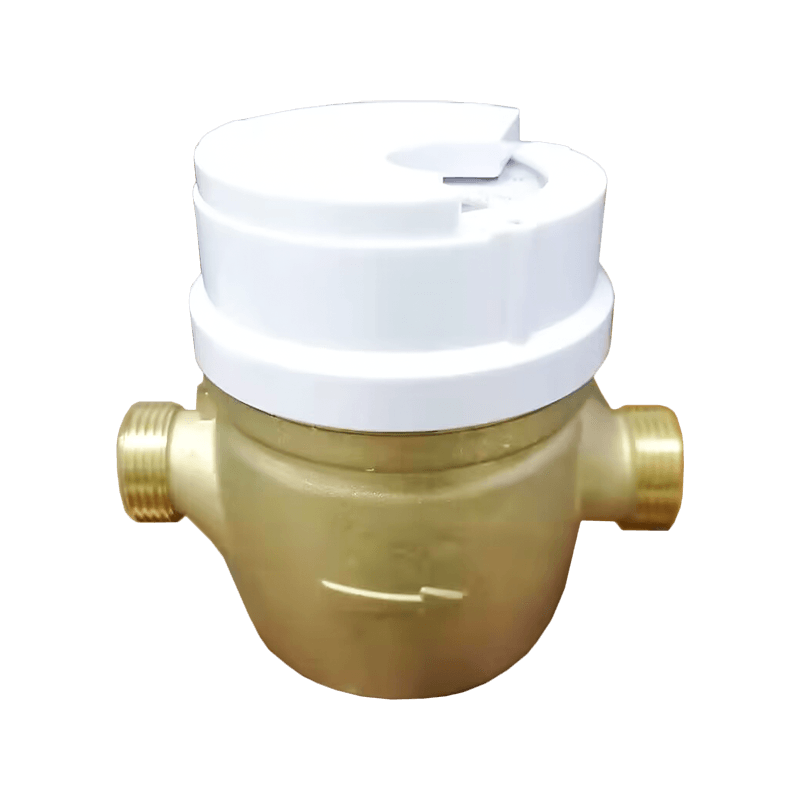
Multi-jet meters are the most common type for residential water metering in many regions. Water enters the measurement chamber from several jets arranged tangentially around the impeller, which spins smoothly and evenly. The multiple jets distribute the pressure on the impeller, reducing wear and improving repeatability compared with single-jet designs. They are available as wet-dial and dry-dial versions; the dry-dial configuration keeps the register completely dry, so the reading window never fogs and the gear train is protected from water contact. Multi-jet meters work well in horizontal pipelines, cover DN15 to DN50 connections with Q3 values from 1.6 to 10 m3/h, and typically achieve rangeability of R80 to R160. Many utilities choose multi-jet meters because they combine moderate price, good accuracy, and a long service record. Versions with pulse output are also available for simple remote reading and building-level data collection systems.
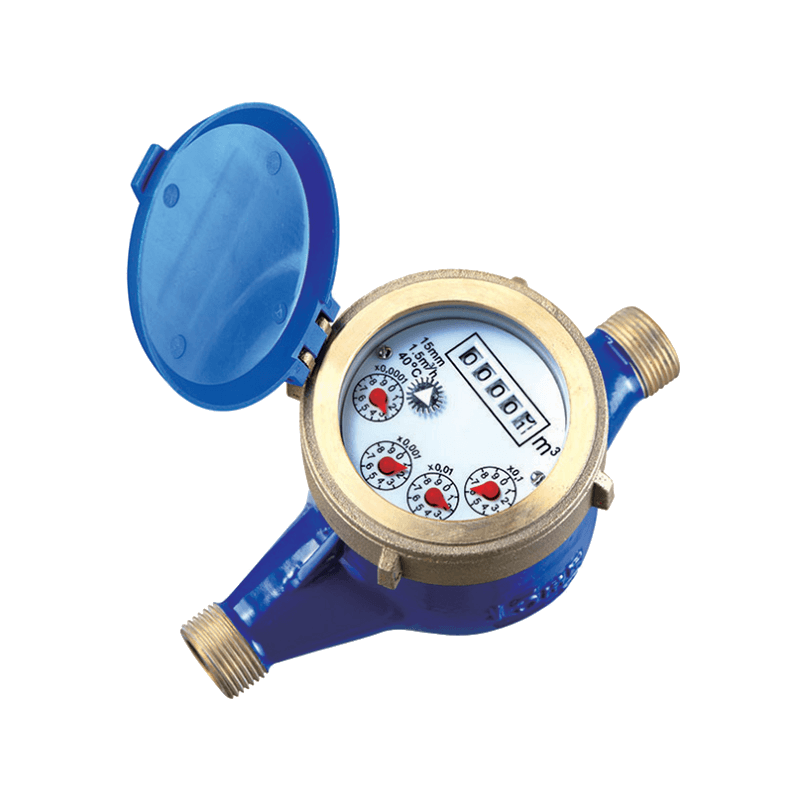 Multi-Jet Dry Dial Water Meter with Pulse OutputThis dry-dial multi-jet meter keeps the register fog-free and protected from water contact, ensuring clear long-term readings. It suits residential pipelines and offers pulse output for remote reading and building-level data collection systems.View Product →
Single-Jet Water Meters
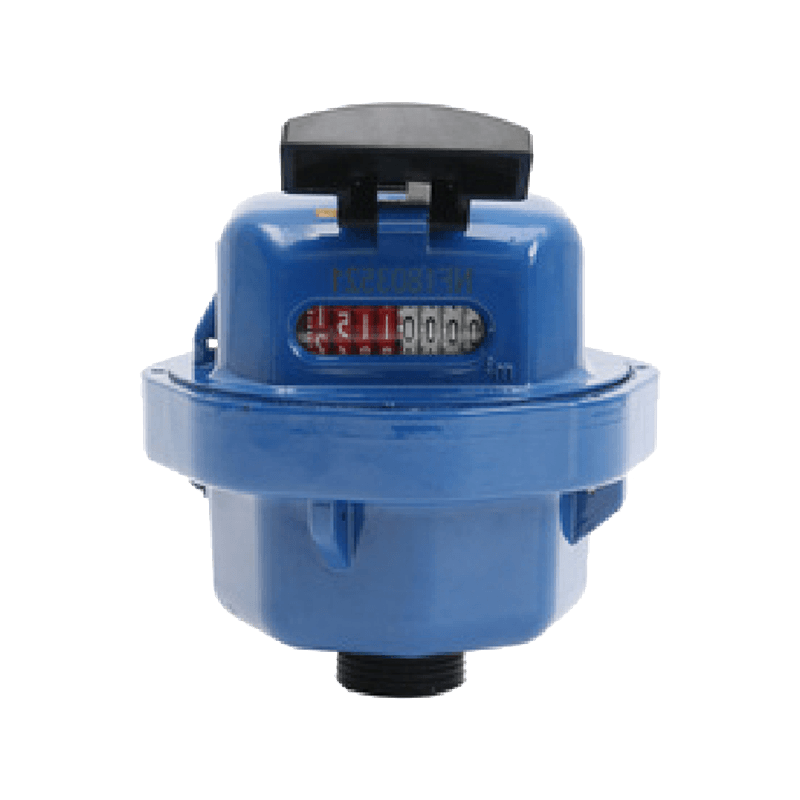
Single-jet meters pass the whole flow through one nozzle directed at a single point on the impeller. The construction is simpler and cheaper than a multi-jet meter, and the open chamber is easy to inspect and clean. Single-jet meters are compact, so they fit in tight spaces and are often used in smaller apartments, housing blocks, and secondary metering points. They are also available in hot-water versions for boiler and hot-water supply metering, as well as impulse-output versions that connect directly to data collection systems. The trade-off is slightly lower accuracy at very low flows compared with multi-jet and volumetric designs, so careful sizing matters more in this category.
Volumetric (Positive Displacement) Water Meters
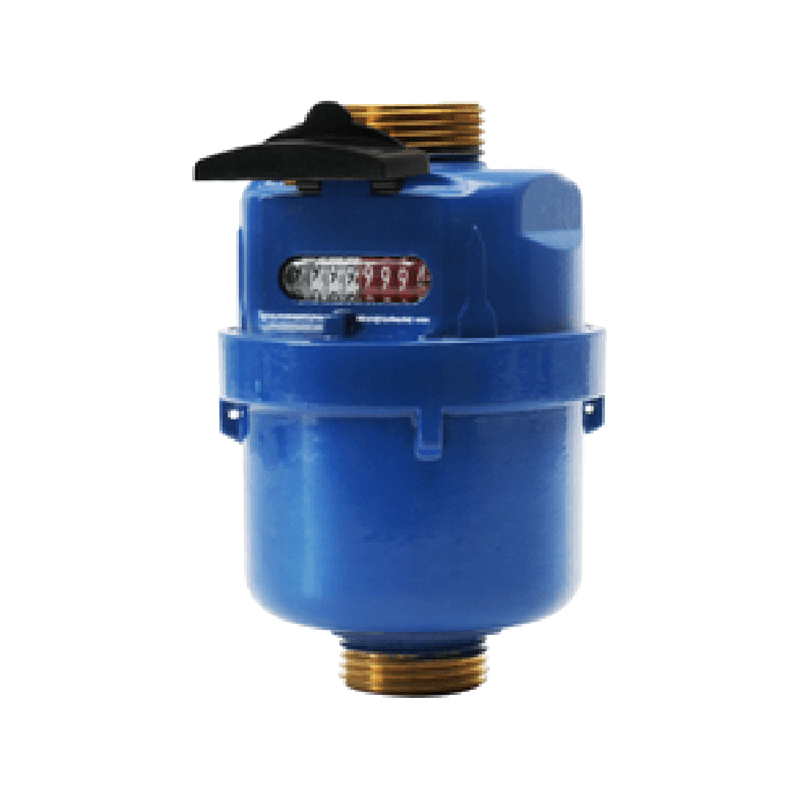
Volumetric meters are the accuracy champions of the mechanical world. Because each stroke or revolution corresponds to a defined volume, they excel at measuring the small, intermittent flows that are common in apartments and single-family homes. They are the preferred choice when consumption is low but billing precision is critical, and they are also used in drinking-water applications where a stainless-steel body guarantees hygienic contact with potable water. Plastic volumetric meters offer a lighter and more cost-effective body while retaining the same measuring principle. The main requirement is clean water: debris and scale must be kept out with a filter or strainer to prevent the piston chamber from sticking or the disc from jamming.
Woltman (Detachable) Water Meters
When the pipe gets larger, the measuring element changes as well. Woltman meters, sometimes called screw-wing or turbine meters, use a propeller that rotates at a speed proportional to the flow velocity across the full pipe cross-section. They are designed for the DN50 to DN300 range and beyond, meaning they are the standard choice for district mains, building supply lines, irrigation, and industrial processes. Two common variants are the WPD horizontal screw-wing meter, where the propeller axis is horizontal and parallel to the flow, and the WS vertical spiral-wing meter, where the axis is vertical. The detachable measurement chamber in these meters can be removed, inspected, and replaced without taking the whole meter out of the pipeline, which keeps maintenance costs low on large installations.
Ultrasonic Water Meters
Ultrasonic meters use transit-time measurement: two transducers send acoustic signals upstream and downstream, and the difference in travel time is directly proportional to the water velocity. Because there are no moving parts, there is no mechanical wear, no pressure drop from an impeller, and no performance drift caused by bearing friction. Ultrasonic meters offer very high rangeability (commonly R250 to R500), outstanding accuracy at low flow, and strong resistance to interference from turbulence and external magnetic fields. They also consume very little power, so battery life often reaches ten years or more. Many smart water metering programs use ultrasonic meters combined with wireless communication, and valve-equipped versions allow the utility to shut off or restart the supply remotely. The higher purchase price is offset by lower maintenance and a much wider measurement range.
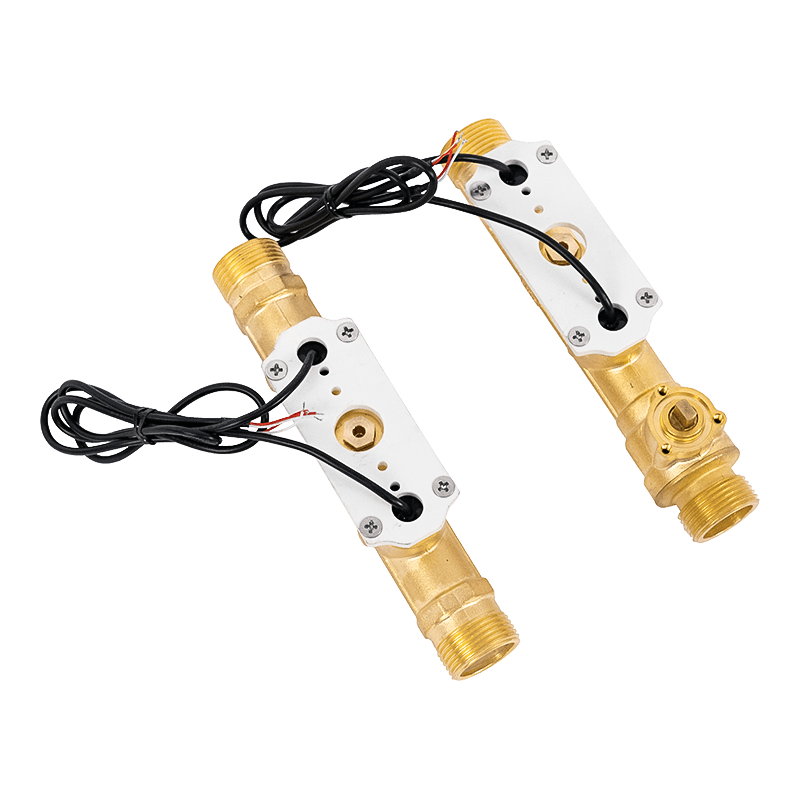 Battery-Powered Ultrasonic Water Meter for Precise Low-Flow MeasurementWith no moving parts and a high rangeability of R250 or more, this ultrasonic meter delivers excellent low-flow accuracy and minimal pressure loss. Its internal lithium battery enables long maintenance-free operation, making it ideal for smart metering programs.View Product →
Electromagnetic Water Meters
Electromagnetic meters apply Faraday's law of electromagnetic induction. A magnetic field is applied across the pipe, and two electrodes pick up a voltage that is directly proportional to the average flow velocity. Like ultrasonic meters, electromagnetic meters have no moving parts, no obstruction in the flow path, and no pressure loss. They can handle dirty water, sewage, and sludge, provided the liquid is sufficiently conductive, which makes them the engineer's choice for water treatment plants, raw water intake, and large industrial metering points. Their power requirement is generally higher than that of ultrasonic meters, so they are more often powered from the grid than from an internal battery. In the water-meter range they typically cover DN25 to DN600, and they are frequently used as reference meters for verification of other metering devices.
| Meter type | Typical size | Common R value | Moving parts | Best-fit application |
|---|---|---|---|---|
| Multi-jet | DN15-DN50 | R80-R160 | Impeller | Residential and light commercial metering |
| Single-jet | DN15-DN40 | R80-R125 | Impeller | Compact residential installations |
| Volumetric | DN15-DN40 | R160-R400 | Piston or rotating disc | High-accuracy domestic metering |
| Woltman | DN50-DN300 | R50-R80 | Propeller | Mains, building inlets, industrial bulk flow |
| Ultrasonic | DN15-DN300 | R250-R500 | None | Smart metering, low-flow detection, remote reading |
| Electromagnetic | DN25-DN600 | R200-R400 | None | Wastewater, raw water, industrial conductive liquids |
Smart Water Metering: Remote Reading and Data Management
Water metering has changed from a purely mechanical activity to a data business. Reading meters manually from door to door is slow, expensive, and prone to error, and it gives the utility only one snapshot per billing period. Smart water metering replaces the monthly visit with continuous data collection, automatic transmission, and centralized management, so the utility sees usage trends, peak demand, night flow, and potential leaks without entering a single building.
What the industry calls AMR (automatic meter reading) simply automates the reading task: the meter data is collected, usually once a day, and transferred to the billing system. AMI (advanced metering infrastructure) goes further: it provides two-way communication, so the utility can not only read data but also update firmware, change tariff structures, and remotely control the valve. Most new water metering deployments are built on AMI principles even when they use the narrowband networks described below.
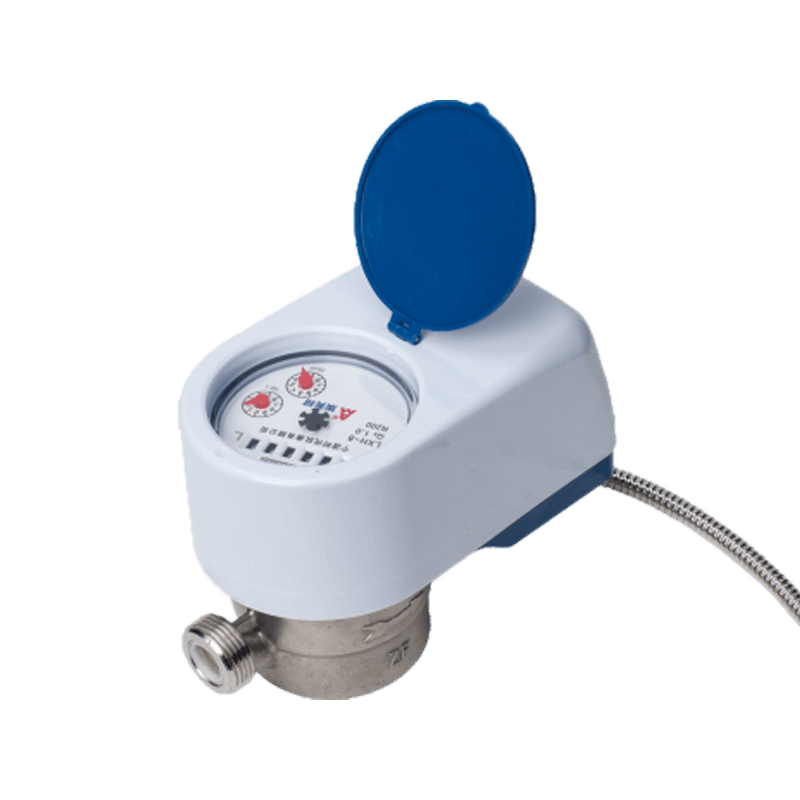
The core of a smart system is a meter with a communication interface. The simplest interfaces are pulse outputs and M-Bus, which are widely used in building-level data collection networks. Photoelectric direct-read meters take this further: they read the numerical position of the odometer wheels using photoelectric sensors, so the transmitted reading is exactly the mechanical reading shown on the register. This prevents the small digit errors that can occur in pulse-counting systems when power is interrupted between readings. Photoelectric meters can also be combined with a built-in valve, enabling remote shutoff for non-payment, tenant changes, or emergency response.
For wide-area networks, three wireless technologies dominate modern water metering. NB-IoT (Narrowband Internet of Things) operates on licensed cellular spectrum, offers deep indoor penetration, low power consumption, and connects directly to the cellular network without gateway equipment. LoRa operates on unlicensed spectrum and is ideal for private networks where the utility wants its own gateway infrastructure and wants to avoid per-connection cellular fees. Cat-1 is a cellular technology with higher data rates, suitable for applications that need more frequent data exchange or larger payloads, such as district metering with half-hourly readings or remote firmware upgrades over the air.
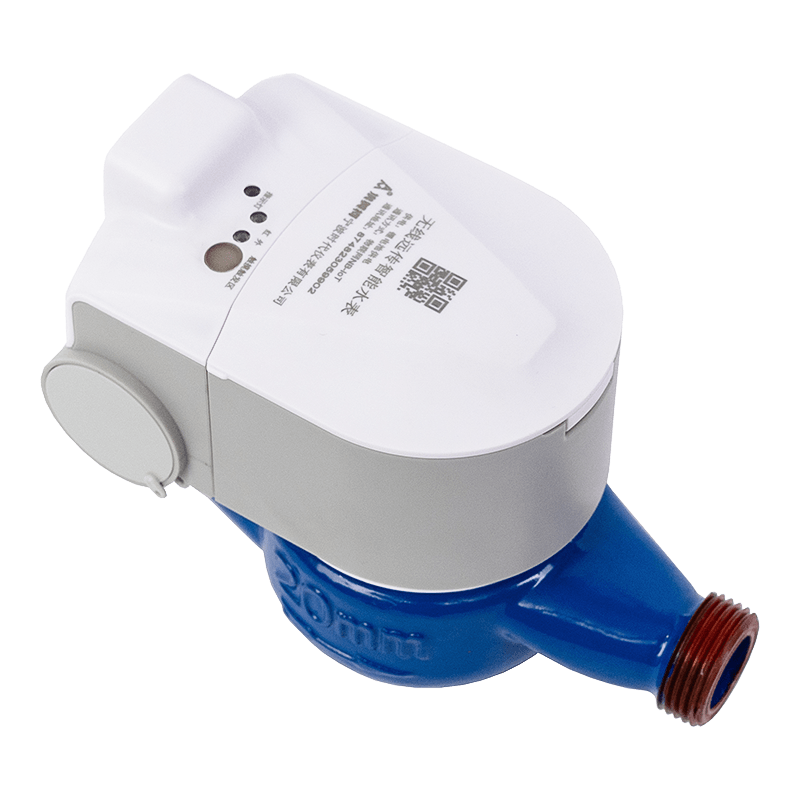 NB-IoT Wireless Water Meter with Prepayment and Valve ControlThis meter uses NB-IoT for direct cellular connectivity without gateways, featuring a built-in valve for remote shutoff and prepayment capability. Its IP68 protection and long battery life support reliable, low-power smart water management.View Product →
Prepayment is another growing branch of smart water metering. Prepaid IC card meters let the user buy water credit before use, which is common in rental housing, student dormitories, and budget-managed apartments. Bluetooth prepaid versions allow a mobile phone to manage the card and account locally, avoiding the need for a dedicated card reader at the meter. When the credit runs out, the built-in valve closes until the account is recharged, giving water utilities a straightforward and enforceable billing model.
All these technologies converge in the software platform that manages the metering data. A typical system collects hourly or daily readings, analyzes night-flow patterns to flag leaks, generates alarms for tampering or reverse flow, and produces the billing data automatically. For utilities, the business case is usually built on reduced manual reading cost, reduced non-revenue water, faster leak detection, and improved customer service.
Related reading
| Technology | Network type | Typical battery impact | Best use case |
|---|---|---|---|
| NB-IoT | Licensed cellular | Low | Direct-to-cloud metering, deep indoor coverage |
| LoRa | Private, unlicensed | Very low | Utility-owned area networks with gateways |
| Cat-1 | Licensed cellular | Moderate | Frequent data exchange and remote valve control |
| M-Bus or pulse | Wired | Not applicable, external power available | Building-level collection with concentrators |
Performance Comparison: Rangeability and Accuracy Across Metering Technologies
Performance comparison is where most water metering decisions are actually decided, and the single most useful indicator is the rangeability ratio R.
The R value expresses how wide a flow range the meter can cover while staying within its accuracy limits. It directly determines whether a meter will register the small night-time trickle that often reveals a leak, and whether it can handle occasional peak demand without being overloaded.
The chart below compares typical R values for the six main technologies. The values come from common specifications on DN15 to DN50 meters and represent the kind of performance a buyer can expect to see referenced in current manufacturer datasheets.
Typical rangeability (R = Q3/Q1) by water metering technology
Representative typical values; actual R values vary by model, size, and national type approval.
Several practical conclusions follow from this comparison. First, electronic meters, particularly ultrasonic meters, offer the widest flow range on a single body, which matters when the same meter must read both slow night-time leakage and high daytime demand. Second, volumetric meters deliver the best low-flow sensitivity among mechanical designs, because every stroke of the piston represents a real, measurable volume rather than an inferred velocity. Third, multi-jet meters sit in the middle of the mechanical range and remain a reliable all-rounder, but they begin to lose accuracy below roughly 10 to 15 liters per hour at DN15. Fourth, single-jet meters have a more modest R value because the single nozzle produces a less uniform impeller drive at very low flows. Fifth, Woltman meters are optimized for continuous high flow rather than low-flow sensitivity, exactly what a mains or building inlet experiences on a normal day. Sixth, the R value also has a revenue effect: water that passes unreported at low flow is water the utility cannot bill. Seventh, non-revenue water specialists therefore prefer meters with high R values and combine them with hourly data collection to identify night-flow anomalies. Eighth, in practice, the mechanical wear of moving parts gradually narrows the effective rangeability of impeller and propeller meters, which is why verification intervals exist. Ninth, electronic meters avoid this drift because they have no bearing friction, although their long-term performance still relies on stable transducers and clean coupling surfaces. Tenth, higher rangeability also simplifies meter selection because one meter size can serve installations with very different consumption patterns. Eleventh, however, the practical conclusion is that R value alone does not define the best meter: the duty profile, water quality, and price of the metering point must all be weighed together.
How to Choose the Right Water Metering Solution
Selecting the correct water meter for a specific project is a matter of matching the meter's certified performance envelope to the actual duty of the installation. Start with the expected flow profile, not the pipe diameter. A DN25 pipe serving three apartments may have a permanent flow of only 2.5 m3/h, and a meter rated at Q3 equal to 4 m3/h with R160 is a much better fit than a larger meter that would never leave its lowest-accuracy zone.
Define the operating conditions next. Is the meter installed indoors or in a buried pit? Will it be exposed to freezing temperatures, direct sunlight, flooding, or vibration? Is the water clean drinking water, well water with sand, or hot water from a boiler? Each condition points toward a specific construction: brass or stainless-steel body, dry dial, hermetic sealing, weatherproof communication module, or a hot-water rated element. Material compatibility is not a detail; it is a safety and reliability requirement.
Then decide what data you need. A building owner collecting one reading per month may only need a low-cost multi-jet meter read visually. A utility running a district metered area needs hourly or continuous data, which means pulse output, M-Bus, NB-IoT, LoRa, or Cat-1 communication. If tenant billing is involved, a prepaid IC card or valve-controlled smart meter removes the collection problem entirely. If the main concern is leak detection, choose a meter with high rangeability and a communication module that reports night-flow data.
Cost analysis should follow the full lifecycle, not the purchase invoice. A cheaper mechanical meter may require verification, cleaning, or replacement sooner in aggressive water conditions; a more expensive ultrasonic meter eliminates moving-part wear but needs a reliable battery and stable transducers. Utilities that have adopted smart water metering typically find that the labor savings from automatic reading exceed the additional hardware cost within a few years, and that the reduction in non-revenue water pays for the communication investment even faster.
Common application scenarios
|
Key selection points
|
Installation, Maintenance and Compliance
Even the best water meter will disappoint if it is installed poorly or ignored after commissioning. The first rule of installation is to respect the manufacturer's stated position requirements. Many mechanical and electronic meters must be mounted horizontally with the register facing upward; some models allow vertical installation or any orientation, but this must be confirmed before ordering, not discovered on site.
Upstream and downstream straight pipe runs are another critical point. Turbine and Woltman meters generally require a straight stabilizing length upstream so that swirl and asymmetric flow do not corrupt the measurement. The often-quoted rule is five pipe diameters upstream and two diameters downstream, although modern ultrasonic meters are increasingly tolerant of disturbed flow and can be installed in compact shafts. If the available space is short, a flow straightener should be used.
A strainer or filter is strongly recommended upstream of volumetric and single-jet meters. Particles, rust scale, and welding debris in a newly commissioned network are the most common causes of blocked measuring chambers and premature bearing wear. Purging the pipeline with clean water before meter installation removes foreign matter before it reaches the meter. Isolation valves on both sides of the meter make it possible to remove the meter for verification without draining the whole riser.
Maintenance differs by technology. Mechanical meters should be checked for reading drift, unusual noise, and erosion of the register; they are also subject to national verification intervals, usually between six and ten years depending on the jurisdiction. Electronic meters need a battery life plan: NB-IoT and LoRa modules are designed for multi-year operation, but the battery should be replaceable and the replacement date recorded in the asset register. Ultrasonic meters have no moving parts, but the transducer coupling and the measuring tube must be kept free of scale and trapped air. Where meters are installed outdoors, freeze protection and sealed cable entries are essential.
| Task | Recommended frequency | Applies to |
|---|---|---|
| Visual inspection of dial, seals, and body condition | Every 6 to 12 months | All meter types |
| Clean strainer or filter upstream of the meter | Annually or at verification | Volumetric and single-jet meters |
| Accuracy test and verification | Per national cycle, typically 6 to 10 years | All mechanical meters |
| Communication test and meter data audit | Every 6 to 12 months | Smart and wireless meters |
| Replace communication battery | Per manufacturer schedule, typically 6 to 10 years | NB-IoT, LoRa, Cat-1 meters |
| Check transducer coupling and measuring tube | At verification interval | Ultrasonic meters |
Compliance is the framework that makes water metering trustworthy. The international metrological standards are ISO 4064-1 and OIML R49, which define the flow range, accuracy classes, pressure loss, and test procedures for cold water meters; the European Measuring Instruments Directive (MID) applies within the EU. Meters used for drinking water must also comply with material safety standards such as NSF/ANSI 61 or equivalent national potable-water requirements, which restrict the substances that can leach from the wetted parts. When purchasing meters that will be sold into regulated markets, always confirm that the model carries the relevant type approval and that the delivered units are accompanied by the required verification documentation.
Frequently Asked Questions About Water Metering
What is water metering and why does it matter?Water metering is the measurement of the volume of water consumed by a building or process, recorded by a water meter and used for billing, resource management, and leakage control. It matters because it turns an invisible resource into accountable data: utilities can charge fairly for water, identify leaks early, forecast demand, and encourage conservation through transparent usage feedback. |
What is the difference between a single-jet and a multi-jet water meter?A single-jet meter directs the whole flow through one nozzle that strikes the impeller at one point, which makes the construction simple and cheap but creates uneven bearing load. A multi-jet meter lets water enter the chamber through several jets arranged tangentially around the impeller, which balances the rotation, improves accuracy, and lengthens service life. For most residential projects, multi-jet meters are the safer choice if the budget allows. |
Which type of water meter is the most accurate?Among mechanical meters, volumetric (positive displacement) meters offer the highest accuracy at low and variable flow rates, because every piston stroke represents a defined volume. Among all meters, ultrasonic and electromagnetic meters are at least as accurate, have no moving parts, and maintain their performance over a much wider flow range. The phrase "most accurate" is not absolute: accuracy also depends on correct sizing, installation conditions, and verification state. |
Can smart water meters be integrated with an existing billing system?Yes, in most cases. Smart meters transmit consumption data in standardized formats through pulse outputs, M-Bus, or wireless protocols, and the data is then processed by metering platforms or utility billing software. Photoelectric direct-read meters are especially convenient because they transmit the same digits that appear on the register, eliminating conversion errors. Before purchase, verify interface compatibility and data format requirements with the software provider. |
How often should a water meter be replaced or verified?The verification interval is normally set by national regulation and typically falls between six and ten years for mechanical cold water meters. Electronic meters often have longer service intervals, but the battery in a smart meter must be replaced according to the manufacturer's schedule. A meter that fails verification must be cleaned, repaired, or replaced, and any meter showing visible corrosion, a fogged dial, or abnormal readings should be checked immediately. |
When should I use a prepaid water meter?Prepaid meters are a practical choice for rental apartments, dormitories, commercial tenants, and any billing relationship where collecting payment after usage is difficult. The user loads credit onto an IC card or mobile account before consuming water, and the built-in valve closes when credit runs out. This model eliminates arrears, reduces collection disputes, and gives the consumer real-time control of water spend. |
Conclusion: Working with a Professional Water Meter Supplier
Water metering is a mature industry, but the technology is not standing still. Mechanical meters still dominate the installed base, smart meters are winning the new projects, and communication capability has become a selection criterion as important as accuracy. The connecting thread is engineering judgment: matching a certified meter, with the right flow range, the right materials, and the right communication interface, to the real conditions of the site.
For procurement professionals, utilities, and distributors, the reliability of the supplier matters as much as the reliability of the meter. A professional water meter manufacturer should be able to provide the complete technical file: type approval certificates, accuracy test reports, material compliance documents, installation instructions, and a clear statement of warranty and after-sales support. A supplier with in-house production and engineering control can also respond to special requirements, such as custom connection threads, special dial prints, private labeling, or tailored OEM and wholesale programs.
Ningbo Times Instrument Co., Ltd. has been designing and manufacturing AMICO-brand water meters since 2001, with over 23 years of industry experience, a 12,000 m2 production facility, and more than 1,000 completed engineering cases worldwide. The product range covers multi-jet and single-jet meters, volumetric and stainless-steel drinking water meters, Woltman bulk meters, photoelectric direct-read meters, prepaid IC card meters, NB-IoT, LoRa, and Cat-1 wireless meters, ultrasonic and electromagnetic meters, and ultrasonic heat meters. This single-source capability, backed by the AMICO Group's sales and service network, allows buyers to consolidate their water metering requirements with one accountable partner instead of managing multiple suppliers.
The practical message of this guide is simple. Define the flow profile honestly, choose the accuracy and communication class deliberately, plan for verification and maintenance, and buy from a manufacturer that can provide documented quality and responsive support. If the metering point matters, the meter deserves as much engineering attention as the pump and the pipe.