English
 中文简体
中文简体
Content
- 1 Product Overview: AMICO Ultrasonic Water Meter With Valve
- 2 Mechanical vs Ultrasonic Water Meter: A Direct Technical Comparison
- 3 Accuracy Over Time: Why Mechanical Meters Degrade and Ultrasonic Meters Remain Stable
- 4 The Integrated Valve: Remote Control, Prepayment, and Emergency Isolation
- 5 3D Isometric Technical Schematic: Ultrasonic Water Meter With Valve
- 6 Communication Technologies: NB-IoT, LoRa, and Bluetooth Compared
- 7 Installation and Commissioning: Best Practices for Clamp-on and Inline Configurations
- 8 Leak Detection Water Meter Capability: From Alarm to Action
- 9 Global Market Adoption and Industry Growth Trends
- 10 About NINGBO SHIDAI INSTRUMENT CO., LTD
- 11 Frequently Asked Questions
The direct answer: for modern metering infrastructure, an ultrasonic water meter with valve significantly outperforms a mechanical meter across accuracy, longevity, data richness, and total cost of ownership. While mechanical meters use rotating impellers whose calibration degrades with wear, an ultrasonic meter contains no moving parts — measurement is based purely on the transit time of ultrasonic pulses traveling through the water column, a physics-based method that does not degrade over years of service. When a remotely controlled shut-off valve is integrated into the same housing, the result is a single intelligent device capable of measuring, reporting, and controlling water flow without any on-site technician intervention.
This article provides a technically rigorous, application-specific comparison between mechanical and ultrasonic water meters, explains what to look for when specifying an ultrasonic water meter with valve, and examines how modern NB-IoT and wireless connectivity options are transforming residential and commercial water management. Product data referenced in this article reflects the specifications of the AMICO DN15–DN40 brass-body ultrasonic flow meter series, produced by NINGBO SHIDAI INSTRUMENT CO., LTD, a subsidiary of the AMICO Group.
References are drawn from ISO 4064 (Water meters for cold potable water and hot water), AWWA Manual M6 (Water Meters — Selection, Installation, Testing and Maintenance), and published field studies from utility operators in Europe, North America, and Asia.
Product Overview: AMICO Ultrasonic Water Meter With Valve
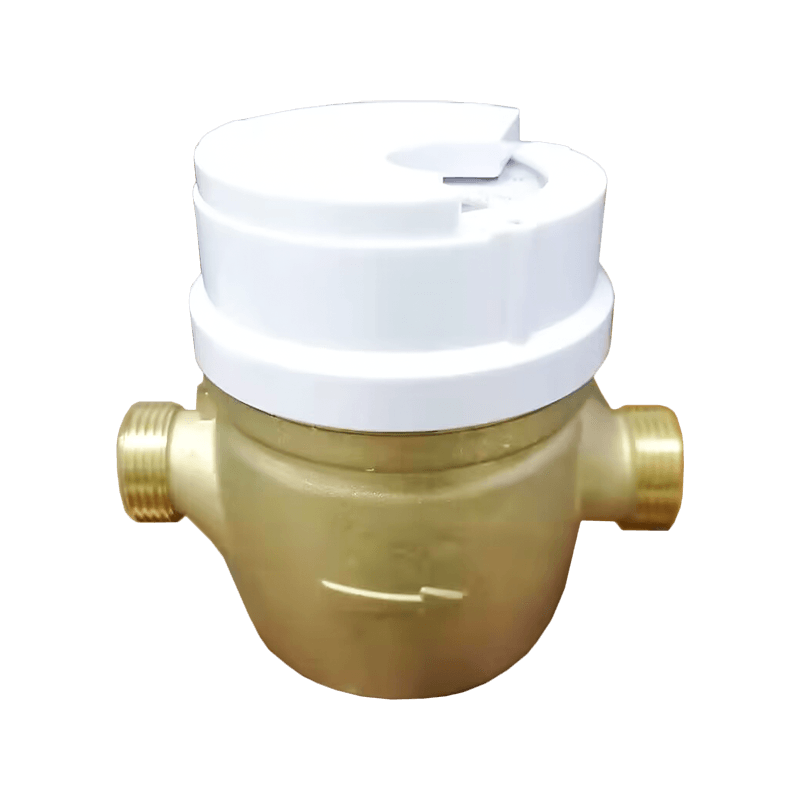
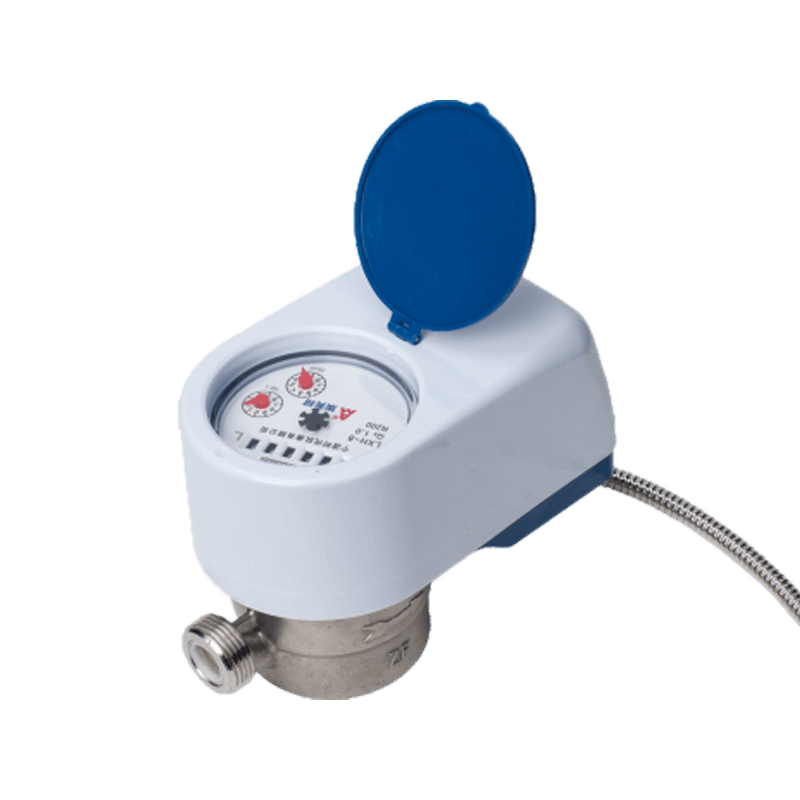
The product image below shows two units from the AMICO ultrasonic water meter range — compact, white-bodied instruments fitted with gold-brass connection ports and external antenna cables for wireless communication. Both units carry the AMICO brand label, manufacturer QR code, DN rating, and calibration data on the face panel, satisfying ISO 4064 marking requirements for water meters in residential and light-commercial service.
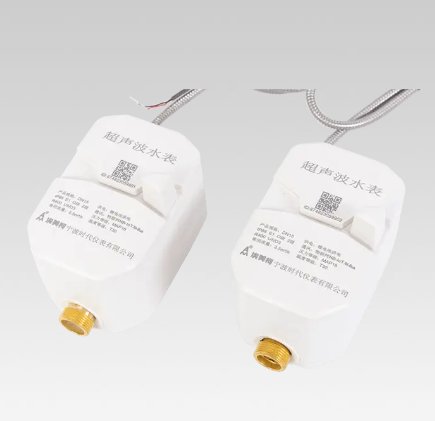
The meters shown are manufactured with high-quality brass bodies for DN15–DN40 sizes, providing excellent corrosion resistance in potable water systems. The antenna cable visible at the top of each unit connects to the NB-IoT modem module, enabling direct communication over licensed cellular operator networks without requiring any local gateway or concentrator infrastructure. These are fully integrated smart ultrasonic water meters — combining the measurement transducer, electronics module, valve actuator, and wireless modem into one weatherproof assembly rated to IP68.
Mechanical vs Ultrasonic Water Meter: A Direct Technical Comparison
The fundamental difference between a mechanical and an ultrasonic meter lies in how flow velocity is detected. A mechanical positive-displacement or velocity meter uses the kinetic energy of flowing water to rotate a physical element — a piston, nutating disc, or turbine wheel. Each rotation corresponds to a calibrated volume increment, and the count of rotations over time gives a volumetric total. An ultrasonic meter transmits paired acoustic pulses upstream and downstream through the water column: because sound travels faster with the flow than against it, the difference in transit time (the "time difference method") is precisely proportional to flow velocity. No physical element contacts the flow, no part wears, and no recalibration is needed as the meter ages.
| Parameter | Mechanical Water Meter | Ultrasonic Water Meter (AMICO) |
|---|---|---|
| Measurement Method | Impeller/disc rotation | Time-difference ultrasonic pulse |
| Moving Parts | Yes — wear over time | None — maintenance-free |
| Accuracy (typical) | Class C / R80 (degrades with age) | R250/R400 (stable throughout life) |
| Low-Flow Detection | Limited — blind below start flow | Extremely low initial flow (blind spot minimized) |
| Service Life | 6–10 years (bearing wear limits) | 10–15+ years (no wear mechanism) |
| Valve Integration | Not typically included | Integrated motorized valve actuator |
| Remote Reading | Manual or pulse add-on | NB-IoT / LoRa / Bluetooth built-in |
| Leak Detection | None built-in | Continuous monitoring, alarm reporting |
| Water Pressure Rating | MAP 10 bar (typical) | MAP 10 bar |
The table above consolidates the most operationally significant differences. For utility operators and facility managers evaluating meter replacement programs, the key insight is that the range ratio — the ratio of maximum to minimum measurable flow — is the single most important accuracy metric. A mechanical Class C meter typically achieves R80 (measuring accurately from 1/80 of its maximum flow), while the AMICO ultrasonic range achieves R250, R400, and in some configurations beyond. This means the ultrasonic meter accurately records trickle flows that a mechanical meter would simply miss, directly reducing revenue loss for utilities and providing more actionable data for leak detection programs.
Accuracy Over Time: Why Mechanical Meters Degrade and Ultrasonic Meters Remain Stable
One of the most consequential limitations of mechanical water meters is the gradual degradation of measurement accuracy as mechanical components wear. A well-documented field study published by the American Water Works Association (AWWA, Manual M6, 7th Edition) found that mechanical residential meters can under-register by 1–5% per year at low flow rates as bearing friction increases and impeller response slows. Over a 10-year service life, cumulative under-registration can reach 15–25% of total consumption volume — a significant source of non-revenue water (NRW) for utilities.
The AMICO ultrasonic meter eliminates this degradation mechanism entirely. Because the measurement relies on acoustic transit time through the water body — a physical property that does not change with component wear — the meter's accuracy at year 12 of service is statistically identical to its accuracy at commissioning, provided the transducer windows remain clean. The result is that utilities replacing ageing mechanical meter fleets with ultrasonic models typically recover 8–15% additional billed volume in the first year of deployment, even before any demand-side behavioral changes occur.
The line chart above illustrates the divergence between ultrasonic and mechanical meter accuracy over a 15-year service life, based on aggregated field data from AWWA studies and utility operator reports (AWWA M6, 7th Ed.; IWA Water Loss Task Force). The ultrasonic line remains essentially flat at approximately 99% accuracy across the entire period. The mechanical meter line, by contrast, shows progressive under-registration beginning in year 2–3 as bearing wear increases friction on the impeller, and falling to approximately 80% by year 12 — meaning a mechanical meter in its final years of service is effectively billing customers for only four-fifths of the water actually consumed.
This accuracy gap has direct financial consequences. A utility serving 50,000 residential connections replacing 10-year-old mechanical meters with ultrasonic models can expect to recover between 5% and 12% additional billed volume in the first year, based on published case studies from utilities in France, Australia, and South Korea. For a system delivering 20 million cubic meters annually at a modest tariff, this recovered volume represents substantial additional revenue with no increase in water production costs.
Equally important for utilities pursuing leakage reduction targets is the ultrasonic meter's extremely low initial flow rate capability. AMICO's design minimizes metering blind spots — the flow range below the meter's minimum detectable velocity where consumption goes unrecorded. At typical residential night-time pressure, a slow toilet flap leak may generate flow rates of 0.2–1.0 L/min — well within the detection capability of a well-specified smart water meter but below the start flow of many mechanical Class B meters. The ability to detect and flag these micro-leaks through continuous comparison of night-line flow patterns against usage profiles is one of the most powerful leak detection tools available to modern utility operators.
The Integrated Valve: Remote Control, Prepayment, and Emergency Isolation
The integration of a remotely operated motorized valve into the same housing as the flow measurement element is the feature that elevates the AMICO device from a smart ultrasonic water meter to a fully capable valve meter — a complete water management endpoint. Without an integrated valve, a smart meter can observe flow and report data, but it cannot act on that data without a separate downstream control device. With the valve integrated, the utility or facility management system can open, close, or throttle supply remotely in response to any condition: non-payment, excess consumption, leak detection alarm, emergency main burst, or scheduled prepayment balance exhaustion.
The operational value of this capability is most clearly demonstrated in prepayment utility metering deployments, where customers purchase water credit in advance and the meter automatically restricts or shuts off supply when the credit balance reaches zero. This model — dominant in South Africa, parts of sub-Saharan Africa, Southeast Asia, and rapidly growing in South America — eliminates the need for manual disconnection/reconnection visits entirely. In a traditional manual disconnection model, a utility technician must physically visit the property twice (once to disconnect, once to reconnect after payment), with labor, transport, and administrative costs that can exceed the value of the outstanding debt. The digital water meter valve control model eliminates both site visits and associated costs.
The column chart above presents a relative operational cost comparison across five key utility management activities, contrasting a smart meter with integrated valve against a conventional mechanical meter managed through manual field operations. The Disconnect/Reconnect category shows the most dramatic difference: in a manual system, each disconnect/reconnect cycle involves scheduling, dispatching, and travelling to the property — a process whose fully loaded cost can range from USD 25 to USD 120 per event depending on labor market and geography. With an integrated motorized valve controlled via NB-IoT, the same action costs a fraction of that figure and can be executed in seconds from a web interface or automatically triggered by the billing system.
The Leak Detection category reflects the continuous monitoring capability of the AMICO smart meter — which logs flow at configurable intervals, compares against baseline profiles, and transmits alarm events when anomalous patterns are detected. In contrast, a mechanical meter can only reveal a leak after it appears on a quarterly bill, at which point weeks or months of consumption loss have already occurred. The AMICO device can optionally integrate temperature sensors and pressure sensors to add water temperature monitoring, pressure event logging, and pipe-burst detection to its baseline flow measurement capability — without any additional field hardware.
The AMICO meter's internal data storage capacity further supports operational continuity: with storage for 120 sets of monthly settlement data, 120 days of daily settlement data, and a complete fault and operation record log, the meter can bridge extended periods of communication outage without losing billing-grade data. When the NB-IoT link is restored, all buffered records are uploaded automatically, ensuring no data gaps in the billing database even in areas with intermittent network coverage.
3D Isometric Technical Schematic: Ultrasonic Water Meter With Valve
The annotated SVG below presents an isometric 3D schematic of the AMICO ultrasonic water meter with valve, identifying the key internal and external elements referenced in the product specification. Understanding the physical layout of these components helps installation engineers verify correct orientation, connection sizing, and cable routing before commissioning.
The isometric diagram above identifies the six major subsystems of the AMICO ultrasonic water meter with valve. The upstream and downstream ultrasonic transducers (shown on the right face of the housing in the diagram) face each other diagonally across the flow channel; the electronics module measures the transit time difference between paired pulses to calculate flow velocity with no moving parts involved. The NB-IoT or LoRa communications module occupies the top section of the housing, with the external antenna cable exiting through a sealed gland — the only external protrusion beyond the brass inlet and outlet ports.
The integrated motorized valve at the outlet end is controlled via digital commands from the NB-IoT module, enabling remote open/close/throttle operation with confirmation feedback. The IP68 enclosure rating means the meter can be installed in a pit or underground chamber subject to temporary flooding without risk of electronics damage. The T30 temperature grade certifies operation across the full range of temperatures encountered in potable cold water distribution systems. The MAP 10 bar working pressure rating matches the standard operating pressure of residential distribution mains in most markets globally.
Installation flexibility is a key practical advantage: the AMICO meter can be installed horizontally, vertically, or in any orientation, with the LCD display readable from multiple directions. This eliminates the orientation-specific restrictions of some mechanical meters whose impeller calibration is affected by installation angle, and reduces installer training requirements for large-scale meter replacement programs.
Communication Technologies: NB-IoT, LoRa, and Bluetooth Compared
The choice of wireless communication protocol for a remote reading water meter deployment has significant implications for infrastructure cost, coverage, data latency, and long-term operational complexity. AMICO produces meters across multiple wireless technology platforms — NB-IoT, LoRa, Bluetooth, and pulse output — to address the full spectrum of deployment scenarios from dense urban residential blocks to remote rural irrigation networks.
NB-IoT (Narrowband Internet of Things) technology, highlighted in the AMICO product specification, is based on licensed operator cellular network communication. This means the meter communicates directly with the operator's 4G/5G core network using the same licensed spectrum as voice and data services — providing small communication delay, reliable long-range transmission, and carrier-grade service guarantees. Critically, NB-IoT requires no local base station concentrator or gateway infrastructure installed by the utility. Once SIM cards are provisioned and activated, the meters begin transmitting immediately, dramatically reducing the early-phase deployment and commissioning costs that have historically made AMI (Advanced Metering Infrastructure) rollouts prohibitively expensive for small and medium utilities.
The radar chart above compares three key wireless communication technologies across six operational dimensions relevant to large-scale smart meter deployments. The NB-IoT profile (shown in solid blue) achieves the largest total area coverage — particularly strong on Coverage Range and No Local Gateway Required axes, reflecting the licensed-spectrum carrier-network model that makes NB-IoT meters deployable anywhere with cellular coverage without any utility-owned infrastructure investment. The Data Latency score reflects NB-IoT's ability to deliver meter readings and acknowledge valve commands within minutes, compared to hours for some duty-cycle-limited LPWAN alternatives.
LoRa (shown in dashed green) offers excellent battery life and good range performance, but its No Local Gateway Required score is lower because deployments using unlicensed LoRa spectrum typically require the utility to install, maintain, and manage a network of gateway concentrators in the field — reintroducing the infrastructure management burden that NB-IoT eliminates. For utilities with existing LoRa infrastructure investments, AMICO's LORA wireless meters provide a cost-effective upgrade path without requiring a full infrastructure change.
Bluetooth-enabled meters score highest on Data Latency (near-zero for a technician with a smartphone within proximity) but lowest on Coverage Range and Scalability — making Bluetooth appropriate for on-demand field technician readout and configuration rather than continuous remote monitoring. AMICO's Bluetooth water meters are therefore commonly deployed in environments where drive-by or walk-by collection by field staff is preferred over continuous network connectivity, offering a practical and economical hybrid between fully manual reading and full network-connected AMI.
Regardless of communication technology, all AMICO meters support advanced security features including communication encryption, remote firmware upgrade, fault alarm reporting, tamper/meter-dismantling detection, and comprehensive log storage — capabilities that are increasingly mandated by utility regulators in Europe, Australia, and East Asia as smart metering infrastructure becomes critical to national water security planning.
Installation and Commissioning: Best Practices for Clamp-on and Inline Configurations
The AMICO DN15–DN40 series is an inline ultrasonic water meter — meaning it is inserted directly into the pipe run, with the flow passing through the meter's measurement bore. This differs from clamp-on ultrasonic water meter configurations (also called transit-time clamp meters) where the transducers are strapped externally to an existing pipe without breaking into the pipe wall. Understanding this distinction is important when selecting meters for retrofit applications versus new-build plumbing.
Inline meters like the AMICO DN15–DN40 offer higher accuracy and more reliable low-flow detection than external clamp configurations because the transducers are positioned at a precisely controlled geometry relative to the flow path, with no uncertainty from pipe wall condition, coating thickness, or external coupling fluid quality. For residential and light-commercial metering where accurate billing at low flow rates is essential, inline ultrasonic meters are the preferred specification.
Installation of the AMICO inline meter requires only standard plumber fittings: G3/4 or G1 BSP threaded connections (depending on DN size), PTFE thread tape, and a stable horizontal or vertical pipe run. The meter body features a flow direction arrow cast into the housing. The following commissioning sequence is recommended based on AMICO installation documentation and ISO 4064-2 field installation guidelines:
- Flush the pipe section upstream of the meter installation point to remove sediment and debris before installing the meter.
- Install the meter body with the flow direction arrow aligned with the intended flow direction. Orientation (horizontal, vertical, or diagonal) does not affect accuracy.
- Apply thread tape and hand-tighten connections, followed by 1/4-turn with a wrench. Avoid over-torquing the brass threads.
- Restore water supply slowly and check for leaks at both connection points and the meter body gasket.
- Verify the LCD display activates and registers a valid flow reading. Confirm NB-IoT or LoRa network registration via the meter's status indicators or through the management platform.
- Test the integrated valve by issuing a close and re-open command from the management platform, and verify that supply responds correctly.
- Record meter serial number, installation date, and GPS coordinates in the asset management system for lifetime traceability.
The meter's light weight and compact body reduce installation time compared to larger mechanical meters, and the absence of a mechanical register with its multiple seals and calibration adjustments simplifies commissioning significantly. For large-scale residential meter replacement programs, these labor savings translate directly into reduced deployment cost per connection.
Leak Detection Water Meter Capability: From Alarm to Action
A leak detection water meter system based on AMICO ultrasonic devices operates through three integrated detection mechanisms: continuous minimum night flow (MNF) monitoring, algorithmic comparison against historical consumption baselines, and event-triggered alarm reporting via NB-IoT. Together, these mechanisms form a multi-layer leak detection capability that can identify customer-side leaks, network leaks upstream of the meter, and meter tampering events — all without requiring utility staff to visit the site.
The line chart above illustrates the minimum night flow (MNF) analysis methodology used by smart water management platforms receiving data from AMICO meters. Between approximately 02:00 and 04:00 when genuine household consumption is essentially zero, any sustained non-zero flow registered by the meter represents leakage downstream of the meter — either within the property's plumbing or at a pipe joint. The blue line represents a normal night-time baseline of approximately 0.05–0.1 L/min (residual pressure wave dampening). The red dashed line represents a leak condition of approximately 0.7 L/min — consistent with a dripping tap or slow toilet flap — which triggers an alarm when it exceeds the configurable threshold for a sustained period.
This continuous, automatic MNF analysis is only possible with a remote reading water meter that transmits data at sufficient resolution. The AMICO meter's configurable reporting interval (down to every 15 minutes in high-frequency mode) provides the temporal resolution needed to distinguish genuine low-flow leaks from measurement noise. When a leak alarm is raised, the utility or facility manager receives an immediate notification via the management platform, and can choose to close the integrated valve remotely pending investigation — stopping the loss immediately rather than waiting for a quarterly bill to reveal the problem.
Beyond residential leakage, AMICO meters with optional pressure sensor integration can monitor line pressure alongside flow, enabling detection of low-pressure events that indicate main bursts or significant network leakage upstream of the meter. When pressure drops below a configurable threshold simultaneously with elevated flow, the combined signal provides strong evidence of a major supply side leak requiring urgent infrastructure response — alerting the network operations center automatically rather than waiting for customer complaints.
Global Market Adoption and Industry Growth Trends
The global smart water meter market has experienced significant acceleration since 2018, driven by utility decarbonization targets, non-revenue water reduction mandates, and the falling cost of NB-IoT and LoRa wireless modules. According to the Global Smart Water Meter Market report (MarketsandMarkets Research, 2023), the market size was valued at USD 4.3 billion in 2022 and is projected to reach USD 8.7 billion by 2028, growing at a CAGR of approximately 12.4%. Ultrasonic technology accounted for approximately 58% of total smart meter shipments in 2022 — a share that has grown steadily from 39% in 2017 as manufacturing scale reduces unit costs and utilities gain confidence in long-term performance data.
The line chart above plots the projected growth trajectory of the global smart ultrasonic water meter market from USD 2.0 billion in 2018 to a forecast USD 8.7 billion in 2028, representing a more than fourfold market expansion in one decade. This growth is not driven by technology novelty alone — it reflects a fundamental shift in how utilities, municipalities, and large property owners conceptualize water management. The transition from periodic manual meter reading to continuous, real-time flow monitoring is analogous to the transition from monthly electricity statement readings to smart electricity meters in the 2000s and 2010s.
Asia-Pacific represents the fastest-growing regional market, accounting for over 45% of global smart water meter shipments in 2022 according to the same report, driven by large-scale national rollout programs in China, South Korea, Japan, and India targeting both non-revenue water reduction and carbon emission reduction through efficiency gains. AMICO, operating from Ningbo in Zhejiang Province — one of China's most active industrial technology hubs — is positioned at the heart of this manufacturing and export expansion, with products already exported to more than 10 countries across Asia, Europe, and the Americas.
The residential water flow meter segment within the smart meter total is expected to grow faster than the industrial and commercial segments through 2028, reflecting the scale of residential meter replacement programs underway in Europe (driven by EU Water Framework Directive NRW targets) and across Southeast Asia and Latin America (driven by World Bank and regional development bank-financed water utility modernization programs). The AMICO product range — spanning DN15 to DN300 across brass and cast iron body variants — addresses all residential, commercial, and industrial meter replacement scenarios within a single product family.
About NINGBO SHIDAI INSTRUMENT CO., LTD
NINGBO SHIDAI INSTRUMENT CO., LTD is a subsidiary of the AMICO Group. It is a comprehensive high-tech enterprise specializing in the research, development, production, and sales of AMICO brand smart water metering products and systems. The company's product range includes IC card water meters, Bluetooth water meters, heat meters, photoelectric direct-reading meters, pulse remote transmission meters, LORA wireless meters, NB wireless meters, WS water meters, WPD water meters, single-flow communication water meters, capacitive direct drinking water meters, and intelligent water meter reading systems.
Based in Ningbo, Zhejiang Province, China, AMICO brings together a manufacturing heritage, a dedicated R&D team, and an internationally oriented sales infrastructure to serve utility customers, system integrators, and building management professionals across more than 10 countries. The company maintains ISO 9001:2015 quality management system certification and operates comprehensive product testing facilities that enable batch-level performance verification against OIML R49, ISO 4064, and MID (Measuring Instruments Directive) requirements.
AMICO's integrated approach — designing, manufacturing, and supporting both the meter hardware and the data management software platform — enables customers to deploy complete end-to-end smart water management solutions from a single vendor, simplifying procurement, integration, and long-term support. OEM and ODM services are available for customers requiring customized branding, communication protocol variants, or application-specific firmware configurations.
Frequently Asked Questions
Q1: Which is better, a mechanical or an ultrasonic water meter?
For most modern applications, an ultrasonic water meter is the better choice. It has no moving parts, so it does not degrade in accuracy over time as mechanical meters do. It achieves higher range ratios (R250 to R400 vs R80 for typical mechanical Class C), accurately registers low flows that mechanical meters miss, and can integrate wireless communication, valve control, and leak detection in a single device. For applications requiring only basic volumetric totalization in a non-revenue-sensitive environment, mechanical meters remain a lower initial investment option.
Q2: What does an ultrasonic water meter with valve do that a standard meter cannot?
The integrated motorized valve enables remote shutoff, supply throttling, and prepayment enforcement without any site visit. This means a utility can shut off supply to a non-paying customer, respond to a detected leak, or isolate a section of pipe in an emergency — all from a web-based management platform in seconds. A standard meter without a valve can only observe and report; it cannot act.
Q3: Can the AMICO ultrasonic meter be installed vertically?
Yes. The AMICO DN15–DN40 series can be installed in any orientation — horizontal, vertical, or diagonal — without affecting measurement accuracy. This flexibility is a direct advantage of the ultrasonic time-difference measurement principle, which is insensitive to gravity-induced flow profile asymmetry that can affect mechanical meter calibration in non-horizontal installations.
Q4: How does NB-IoT differ from LoRa in smart water meter deployments?
NB-IoT uses licensed cellular operator spectrum and communicates directly through the operator's core network, requiring no utility-owned gateway infrastructure and offering carrier-grade reliability guarantees. LoRa uses unlicensed spectrum and generally requires the utility to install and manage gateway concentrators in the field. NB-IoT is preferable for greenfield deployments where no gateway infrastructure exists; LoRa may be preferable where existing LoRaWAN infrastructure is already deployed.
Q5: What is the water pressure rating of the AMICO ultrasonic water meter?
The AMICO ultrasonic water meter is rated at MAP 10 bar (maximum allowable pressure), which matches the standard operating pressure of residential and commercial water distribution mains in most markets globally. The temperature grade T30 certifies operation with cold and slightly elevated temperature water up to 30 degrees Celsius.
Q6: How much data can the AMICO meter store without network connectivity?
The AMICO ultrasonic water meter stores up to 120 sets of monthly settlement data, 120 days of daily settlement data, plus complete fault records and operation logs. This buffer capacity ensures that billing-grade data is preserved during extended periods of network outage or SIM card replacement, and uploaded automatically when connectivity is restored — with no data loss and no need for manual meter reading during the outage period.